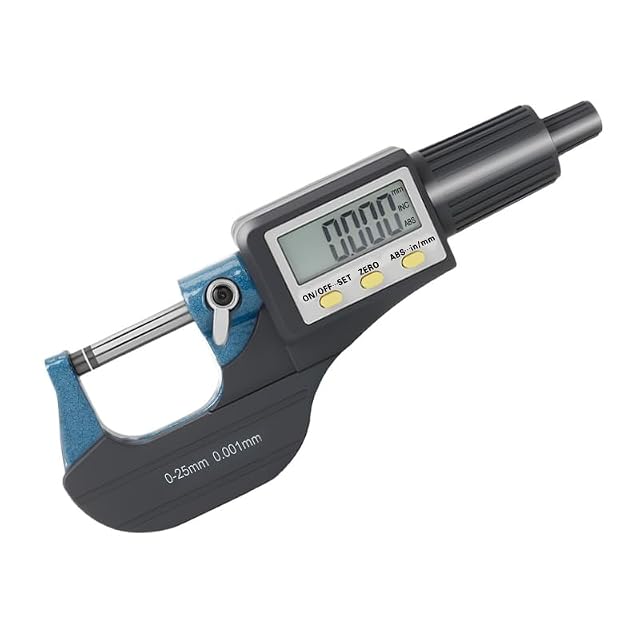
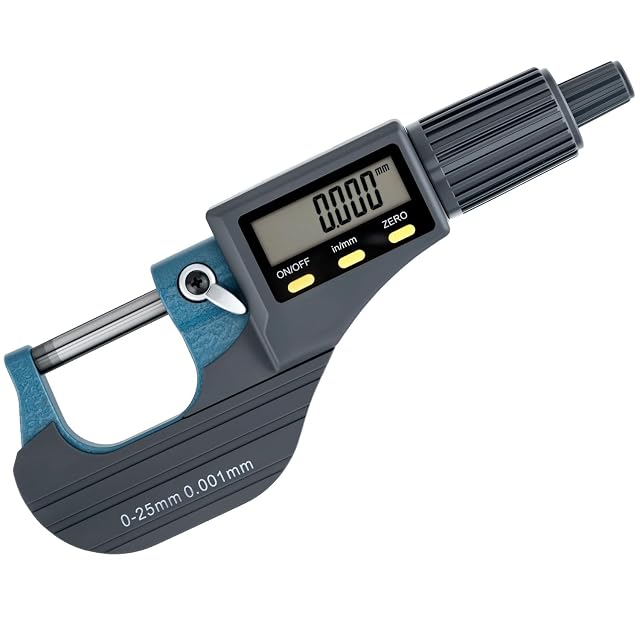
The ratchet exists so that two people get the same reading · review
QWORK Mechanical micrometer, 0–25 mm (0 to 0.98 in) review
A mechanical micrometer over 0–25 mm (0 to 0.98 in) reading to 0.01 mm, with carbide measuring faces and a spindle lock, at a quarter of the price of the digital ones here.
What the figures leave us with The one to learn on. Carbide faces and a lock are the parts that matter; the scale is a skill worth having.
A mechanical micrometer at eleven euros, with the two features that actually determine whether it stays accurate.
What the manufacturer publishes
A measuring range of 0 to 25 mm (0 to 0.98 in) with a resolution of 0.01 mm. Carbide measuring faces, stated for increased durability and precise results over a long period. A locking function that fixes the reading securely. A laser-marked scale on the frame described as clear and fine.
What is not published
No accuracy. The resolution — the finest division that can be read — is stated; the tolerance is not. They are different numbers and only one is here, which is the recurring pattern of this whole category.
Reading a thimble is a skill, and it is worth having
A mechanical micrometer is read by combining the sleeve scale and the thimble scale, and it takes an afternoon to become fluent. What you get in exchange is an instrument with no battery, no auto-off, no drift and nothing to zero — and one that will still read correctly in twenty years if the faces are looked after.
Availability
No such listing: the American Amazon shop answers the reference with a search box rather than a page.
Read from Keepa on the day this page was last revised; stock and price both move without notice.
What it has, and what it lacks
Strengths
Carbide measuring faces, stated for durability and stable results over time
A spindle lock that fixes the reading before the part is removed
No battery: a mechanical micrometer is always ready
The cheapest micrometer here by a wide margin
Compromises
Resolution 0.01 mm, ten times coarser than the digital models here
No accuracy figure published, only the resolution
A thimble scale has to be read, which takes practice the digital ones do not
Specifications
Amazon reference
B0CZ92X5F2 (identical on 5 markets)
EAN
0795973643773
Stated dimension or range
0–25 mm (0 to 0.98 in)
Resolution
0.01 mm resolution
Material
carbide faces
Mechanism and finish
spindle lock
What gets asked here
Is 0.01 mm enough?
For most fitting work, yes — it is finer than any caliper in this hub. The 0.001 mm digital micrometers here are for gauge work and for measuring the same part repeatedly to compare.
Why do carbide faces matter?
The two faces that touch the work are what wears, and wear on them shifts the zero permanently. QWORK states carbide faces for durability and precise results over a long time.
What does the lock do?
It clamps the spindle so the reading does not change while you withdraw the micrometer and read it. On an internal or awkward measurement, that is the difference between a reading and a guess.
Our score
7.2/ 10
The one to learn on. Carbide faces and a lock are the parts that matter; the scale is a skill worth having.
This one’s price among measuring instruments
A reference exists on these Amazon stores: France, Germany, Italy, Spain, United Kingdom. Listed is not the same as in stock — availability changes daily.
Details checked on August 31, 2026.
Who should pick this one, among measuring instruments
Learning to use a micrometer, and for a workshop that wants one that never has a flat battery.
What buyers actually choose
Amazon reports what buyers took in the month before this page was last checked: at least 50.
The figure is a floor, rounded by Amazon, and read through Keepa — it says what buyers picked, not what a maker claims.
Sources
Specifications: the manufacturer sheet for measuring instruments and the matching Amazon product page. Prices and availability: Keepa. Every figure on this page names its source.
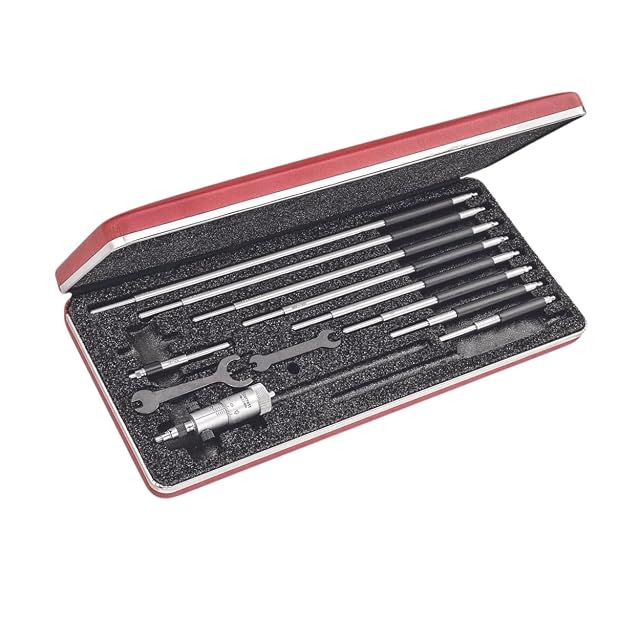
An INSIDE micrometer — it measures bores, not outside dimensions · 50 to 300 mm (1.97 to 11.8 in) from one head and a set of rods, a 250 mm (9.84 in) span assembled with spacing collars · graduated at 0.01 mm · INSULATED rods, each MARKED WITH ITS LENGTH, so the set checks itself · hardened and RADIUS-GROUND anvils · vinyl and steel case · NO accuracy figure and NO standard named
The only micrometer the American relevé returned, and the only instrument on this shelf that measures a bore rather than a part.
Best for: Bores, rings and parallel internal faces from 50 to 300 mm (1.97 to 11.8 in), in a shop that already owns outside micrometers