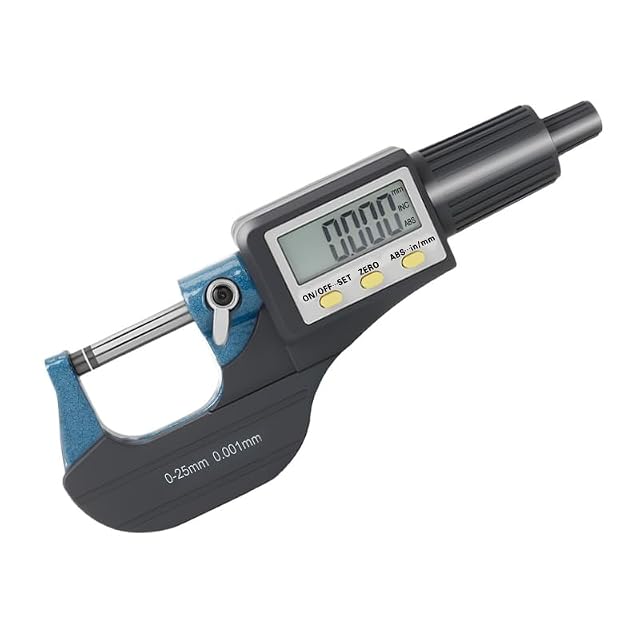
What the figures leave us with Fine resolution, unstated accuracy, alloy faces. The Beslands nearby publishes the number this one does not.
A digital micrometer that gives you three decimal places and no tolerance to go with them.
What the manufacturer publishes
A measuring range of 0 to 25 mm (0 to 0.98 in) with an extremely fine resolution of 0.001 mm. An integrated LCD display for fast, error-free reading. A measuring head in high-quality hardened alloy steel, described as particularly wear-resistant. Power from a CR2032 3 V lithium cell, stated for its high capacity.
Three decimals, and what they are worth
A display reading to a thousandth of a millimeter invites you to believe the last digit. Whether it means anything depends on a tolerance the listing does not state. In practice the last digit of any hand-held micrometer is dominated by how hard you turn the thimble, which is why a ratchet or friction stop exists — and this listing does not mention one either.
Where it sits
Between the mechanical QWORK, which publishes the same class of information for a quarter of the price, and the Beslands, which publishes resolution and accuracy separately for a few dollars more. Its advantage over the first is the display; its disadvantage against the second is the missing number.
Availability
No such listing: the American Amazon shop answers the reference with a search box rather than a page.
Read from Keepa on the day this page was last revised; stock and price both move without notice.
What it has, and what it lacks
Strengths
A 0.001 mm display step, ten times finer than the mechanical micrometer here
An LCD, which removes the sleeve-and-thimble reading skill entirely
A hardened alloy steel measuring head, stated as wear-resistant
A CR2032 lithium cell, stated for long capacity
Compromises
No accuracy figure published — only the resolution
Hardened alloy rather than the carbide faces stated by the QWORK and STEINLE here
A battery to go flat, in a tool used a few times a year
Specifications
Amazon reference
B0F8QS62V2 (identical on 5 markets)
EAN
4895232026913
Stated dimension or range
0–25 mm (0 to 0.98 in)
Resolution
0.001 mm resolution
Probe and body
hardened alloy head
Power
CR2032
What gets asked here
Does 0.001 mm resolution mean 0.001 mm accuracy?
No, and that distinction is the most important one on this page. The display steps in thousandths; how close the reading is to the truth is a separate figure that this listing does not give. The Beslands micrometer in this hub publishes both.
Alloy or carbide faces — does it matter?
Carbide is harder and wears more slowly at the two faces that touch every part. Mcbazel states hardened alloy steel; the QWORK and STEINLE state carbide.
What happens when the battery dies mid-job?
Nothing is readable. A mechanical micrometer has no such state, which is a real argument for owning one of each.
Our score
7.8/ 10
Fine resolution, unstated accuracy, alloy faces. The Beslands nearby publishes the number this one does not.
This one’s price among measuring instruments
A reference exists on these Amazon stores: France, Germany, Italy, Spain, United Kingdom. Listed is not the same as in stock — availability changes daily.
Details checked on August 31, 2026.
Who should pick this one, among measuring instruments
Somebody who wants micrometer resolution without learning to read a thimble.
What buyers actually choose
Amazon reports what buyers took in the month before this page was last checked: at least 100.
The figure is a floor, rounded by Amazon, and read through Keepa — it says what buyers picked, not what a maker claims.
Sources
Specifications: the manufacturer sheet for measuring instruments and the matching Amazon product page. Prices and availability: Keepa. Every figure on this page names its source.
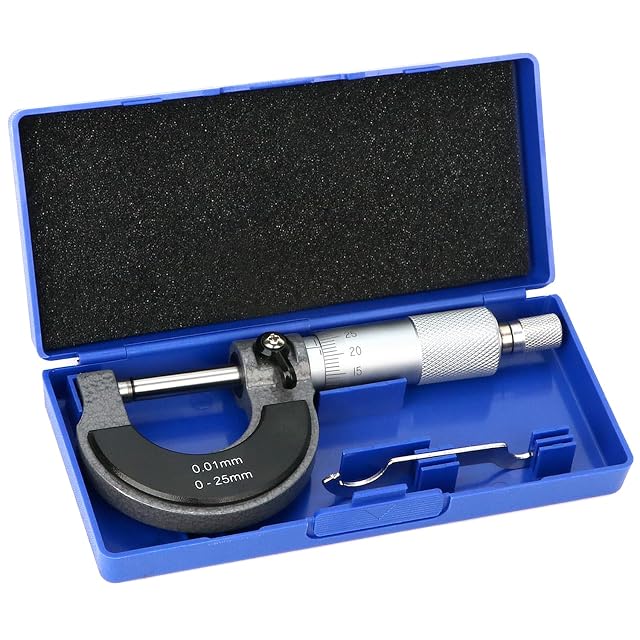
0–25 mm (0 to 0.98 in) · 0.01 mm resolution · carbide faces · spindle lock
A mechanical micrometer over 0–25 mm (0 to 0.98 in) reading to 0.01 mm, with carbide measuring faces and a spindle lock, at a quarter of the price of the digital ones here.
Best for: Learning to use a micrometer, and for a workshop that wants one that never has a flat battery.
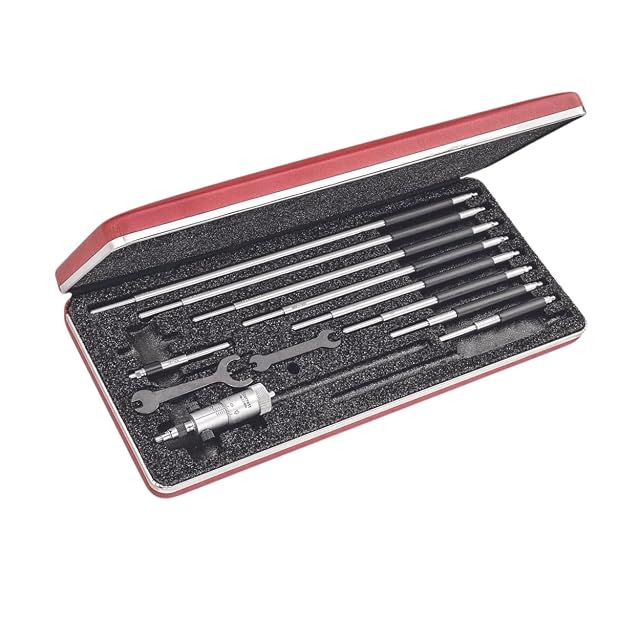
An INSIDE micrometer — it measures bores, not outside dimensions · 50 to 300 mm (1.97 to 11.8 in) from one head and a set of rods, a 250 mm (9.84 in) span assembled with spacing collars · graduated at 0.01 mm · INSULATED rods, each MARKED WITH ITS LENGTH, so the set checks itself · hardened and RADIUS-GROUND anvils · vinyl and steel case · NO accuracy figure and NO standard named
The only micrometer the American relevé returned, and the only instrument on this shelf that measures a bore rather than a part.
Best for: Bores, rings and parallel internal faces from 50 to 300 mm (1.97 to 11.8 in), in a shop that already owns outside micrometers