Setting out a room: the laser, and the three things it needs
A line laser bought alone is a tool looking for a flat surface. Three accessories decide whether it is usable: something to stand it on, something to see the line against, and — outdoors — something to detect a line the eye cannot. Two of the three have compatibility conditions worth knowing before ordering.
The laser is the easy decision. What it needs is where the money and the mistakes are.
The laser: published figure or line count
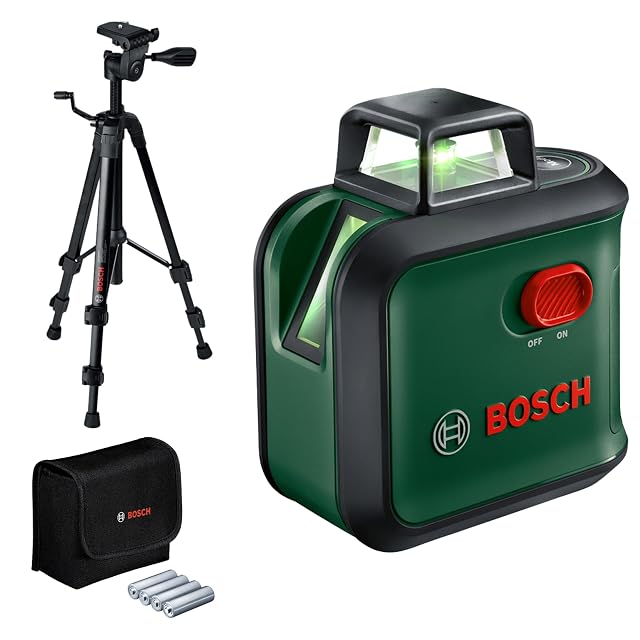
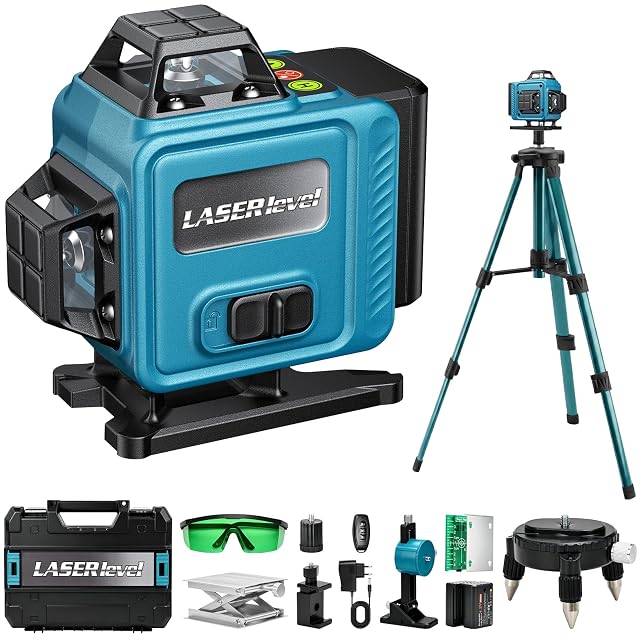
The Bosch AdvancedLevel 360 publishes ± 0.4 mm (0.02 in)/m for its lines and ± 1.0 mm (0.04 in)/m for its plumb point, and comes with a tripod. The Pakinui projects four full 360° planes for a third of the price and publishes no accuracy at all. Those are two different purchases: one sets a datum you can defend, the other wraps a room in reference geometry.
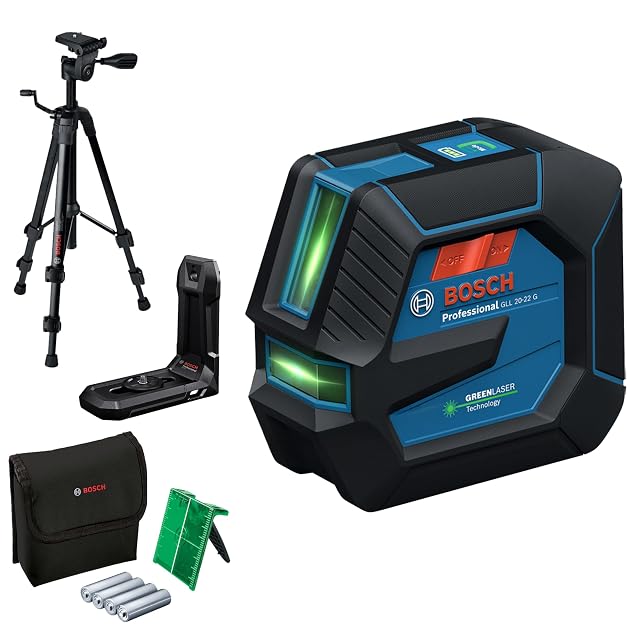
The GLL 20-22 G at the top publishes ± 0.3 mm (0.01 in)/m and arrives with a mount, a target plate, a pouch and a tripod — which is most of the price difference against a bare body.
The tripod, and the thread
Check what is under your laser before buying anything. Compact green line lasers are almost all 1/4”-20; construction tripods are 5/8”. The minimum height matters as much as the maximum — a tripod that will not go below 122 cm (48 in) cannot set a line for a skirting or a screed.
The target plate, matched to the diode
Green plate for a green laser, red for red. On dark brick, glass or anything wet, the plate is the difference between a visible line and a guess.
The receiver, and the pulse mode
Outdoors the line is gone within a couple of meters. A receiver restores the working range — provided the laser has a pulse mode, and provided the receiver accepts that diode color. Both conditions are checkable before ordering and neither is negotiable afterwards.
Which instrument does your work demand?
You are hanging things on one wall
A horizontal line laser is enough and it does the job in seconds.
You are tiling or fitting units
A cross-line laser gives you level and plumb at once, which is what setting out actually needs.
You are working in a bright room
Line visibility is the limiting factor, and a detector or a colored beam is the answer.
You are leveling across a whole floor
That is a different tool, and a rotary laser or a water level is the appropriate one.
Picking by the measurement
Hanging and fixing
A single level line across a wall, which is the commonest and simplest use.
Tiling
A cross line to set the first row and the vertical, from which everything else follows.
Fitting kitchen units
Level and plumb references that stay put while both your hands are busy.
Checking a floor or a wall
A laser line reveals how far from level or plumb a surface really is, which is often more than expected.
The figures that settle accuracy accuracy
Self-leveling and its range
Self-leveling units correct within a limited angle and warn outside it. That warning is the feature: a laser that quietly reads out of level is worse than none.
Line visibility
The practical limit indoors in daylight. A green beam is generally easier to see than red, and a detector removes the question altogether.
Mounting
How you fix it matters as much as the laser. A tripod, a clamp or a bracket decides whether the line stays where you set it.
How many lines you need
One line for hanging, cross lines for setting out, more only for specific trades. Extra lines add cost and confusion.
Whether it can be locked
Locking the pendulum for transport prevents damage. A self-leveling laser carried unlocked in a van is a laser that goes out of true.
Which tolerance for which work
The job
The laser
What decides success
Hanging a shelf
A horizontal line
Where you put the mount
Tiling a wall
Cross lines
Setting out the first row
Fitting units
Cross lines
A stable mount
Bright room
Green beam or detector
Visibility, not accuracy
The errors that cost you
Setting out from a wall or floor you assume is straight
Rooms are rarely square or level. The laser tells you the truth, and setting out from it rather than from the building is the whole point.
Not checking the laser against itself
Set a line, turn the laser through 180 degrees and check it lands in the same place. It takes a minute and it catches a laser that is out.
Working outside the self-leveling range
On a sloping floor a self-leveling laser can be beyond its compensation. Most warn; some warn in ways easy to miss.
Transporting it unlocked
The pendulum is delicate. Locking it for transport is what keeps the tool accurate over time.
By the trade you are in
The occasional user
A simple cross-line laser and a clamp. It will cover hanging, tiling and most fitting.
The tiler
A bright cross line, a solid mount, and the habit of setting out from the laser rather than the wall.
The one working in daylight
A green beam or a detector, because visibility rather than accuracy is what limits the tool.
Calibration and how long accuracy holds
A self-leveling laser is a pendulum in a box, and it is damaged by being transported unlocked and by being dropped. Neither shows on the outside, which is why checking it against itself matters more than any other maintenance.
Lock the pendulum before moving the laser.
Check the line by rotating the laser 180 degrees and comparing.
Keep the emitter window clean; dust widens and dims the line.
Remove batteries for long storage.
Safety
A laser at eye height in a room with other people in it.
Never aim the beam at anyone's eyes and be aware of reflective surfaces.
Warn other people in the room, especially at eye height.
Mount it so it cannot fall; a laser on a stepladder is a hazard to itself and to you.
Do not rely on a laser line alone for structural work; verify.
± 0.4 mm (0.02 in)/m stated · 1 × 360° horizontal + 2 vertical · plumb point · tripod included
The cheapest laser in this hub that publishes an accuracy figure: Bosch states ± 0.4 mm (0.02 in)/m for the lines and ± 1.0 mm (0.04 in)/m for the plumb point, with a TT 150 tripod in the box.
Best for: The first laser in this hub you can actually compare to another one, because it publishes the number that comparison needs.
4 × 360° green · self-levels to ≤ 3° · 1/4"-20 thread · 2 × 3000 mAh
The cheapest way into a four-plane green laser: two horizontal and two vertical 360° planes, self-leveling within 3°, on two rechargeable packs. No accuracy figure is published.
Best for: A first line laser for indoor work, if you accept that the maker never says how level its lines are.
± 0.3 mm (0.01 in)/m stated · IP65 · dual power · target plate and tripod included
The tightest published accuracy in this hub at ± 0.3 mm (0.01 in)/m, in an IP65 rubber-armored body that runs on a Li-ion pack or on AA cells, supplied with a mount, a target plate and a tripod.
Best for: Work where the line has to be right and the tool has to survive the site — and where two lines are all a datum needs.
Almost always. A self-leveling laser corrects the tool, not the surface it stands on — and the pendulum cannot tell you it has leveled perfectly on a base that moves. Check the thread first: compact lasers are usually 1/4"-20 and construction tripods are 5/8".
When do I need a receiver?
Outdoors, past a couple of meters, where the line is invisible regardless of diode power. A receiver requires the laser to have a pulse or "receiver" mode — without one, no receiver of any brand will work.
Does the target plate color matter?
Yes. Plates are tinted to a diode color, and a plate sold for green does very little for a red line. It is the single most common accessory mistake in this category.
Do I need a cross-line laser or a single line?
A single horizontal line is enough for hanging. Cross lines give level and plumb at once, which is what setting out for tiling or units actually needs.
Why can I not see the line?
Daylight, distance and surface color all reduce visibility. A green beam is generally easier to see than red, and a detector removes the problem entirely.
How do I check the laser is accurate?
Set a line, rotate the laser through 180 degrees and check it lands in the same place. It is quick and it catches an instrument that has been knocked.
What is self-leveling?
A pendulum mechanism that corrects the line within a limited angle and warns you outside it. That warning is the important part.
Should I lock it before moving it?
Yes. The pendulum is the delicate part, and transporting the laser unlocked is the commonest way these tools go out of true.
Can I use it outdoors?
Only over short distances or with a detector, because daylight makes the line invisible. Outdoor work is usually a rotary laser and a receiver.
Targets, tripods and spares from the same aisle, at the price we noted. Check the thread matches the instrument you pick before ordering: it depends on the mount and the part number, which the listing states.
Bosch 0601091A00 · Laser tripods — 122–295 cm (48 to 116.1 in) · aluminum · Quick Clamp height lock
DEWALT DW0881T · Laser tripods — 72 in maximum, the tallest here, collapsing to 38 in · 1/4" × 20 thread · tilting head with an INTEGRATED LEVEL · non-skid feet · aluminum · carrying pouch · stated compatible with ALL DEWALT line and spot lasers · NO minimum working height and NO load capacity published · $38
AdirPro 790-01 LD-8 · Laser receivers — THE ONLY ACCURACY BANDS ON THIS SHELF: ±1/16 in (1 mm) and ±1/8 in (2.5 mm) · 2000 ft working range, stated "depending on laser" — the only honest qualification here · ROTARY lasers only, and RED only · dual-sided LCD showing elevation, grade sensitivity, audio and battery · built-in bubble level · 9 V for about 40 hours · IP55, the highest here · $85
Bosch LR8 · Laser receivers — Red AND green · extends the GLL3-330CG or GLL3-330C to 330 ft DIAMETER, the GLL3-300 to 300 ft, the GCL 2-160 to 165 ft — the only receiver here that states the range PER LASER · ADJUSTABLE audio for worksite noise · backlit oversized LCD · dual-sided LED arrows · heavy-duty magnets · quick-release rod bracket · IP54 · $120
Bosch Professional 1608M0005C · Laser target plates — For laser distance meters · improved beam visibility · with stand
HOZO C-M02-A02 TargetMate · Laser target plates — TWENTY-NINE DOLLARS, the most expensive plate on this shelf — and the same maker's four-card set costs nineteen for four · magnetic AND washable, the only plate here that is both · stated specifically for the HOZO M-Cube 02 laser measure · NO tint color, NO scale, NO size · $29
The instruments above come from the catalog of this site. Specifications are the ones the manufacturer states and the ones on the Amazon listing; prices are the Keepa reading for the date below, and both change. Ranking uses declared specifications, stated strengths weighed against stated limits, and price. Nothing here has had its accuracy checked by us, and the page says as much.
Last checked on
Prices quoted in these summaries are dated readings. The live price is shown next to each product.
The tool we use ourselves
Chosen your tool? Now buy it at the right price.
Thermal cameras, line lasers and clamp meters swing by thirty dollars or more
across the
year, and the biggest "discounts" often land at prices the same model sold for six weeks
earlier.
UniverTrack tracks the real price history across retailers, spots fake
reductions, and alerts you when it is genuinely the moment to buy.
Real price historyBuy-now alertsAI buying assistant