What the figures leave us with Eighteen dollars buys a published self-leveling range of 4° ± 1°, ±1/8 inch at 30 feet, four feet of drop protection and IP54 — which means it states a tighter accuracy and a longer fall than the eighty-eight-dollar laser on this shelf. For indoor tiling and carpentry that is the sensible purchase here. Budget for a mount, because nothing is included and the magnetic bracket is extra, and accept red over green.
What the maker puts in writing
Two modes on a slide switch: self-leveling and manual · “the range of leveling and compensation is 4°± 1°” · out of level, the laser flashes
Manual mode: self-leveling deactivated, the cross locked at any angle
±1/8 of an inch at 30 ft · red cross line across a 110° wide angle
“Lower energy consumption and longer battery lifespan”
Tripod or magnetic bracket (SOLD SEPARATELY) · 2 AA cells, canvas case, manual · two-year service
No pulse mode. No brightness adjustment.
Four degrees, plus or minus one
Which is more honest than a round number.
The pendulum levels itself while the tool stands within about three to five
degrees of level, and flashes rather than lying beyond that.
The ± 1° is tolerance on the range itself. Most makers quote ±4° and stop.
This shelf’s introduction calls the self-leveling range the specification that
decides whether the tool is usable — the head parks and warns instead of
guessing.
Three of the six lasers here publish a range. One self-levels and never says at
what angle.
Eighteen dollars, and a tighter figure than eighty-eight
One eighth of an inch at thirty feet.
The most expensive laser on this shelf publishes five sixteenths at the same distance —
0.125 inch against 0.3125.
Two and a half times tighter, at a fifth of the price.
What eighty-eight dollars buys instead is IP55 rather than IP54, a locking
pendulum and a Bosch battery platform. Those are real. The accuracy is not where
the money went.
Red, argued rather than apologized for
Which is unusual on this shelf.
The eye is several times more sensitive to green at the same radiated power, so a
red line looks dimmer. The tag above says so.
RockSeed puts current on the other side: a red diode draws less, so two AA cells
run longer — and says it in the bullet rather than hiding the color.
Dim interior: barely shows. Sunlit room: it does. A green laser here costs twenty
dollars more.
And you must buy a mount
Which this shelf’s buying tip turns from advice into a requirement.
Tripod-mountable, magnet-mountable, and the magnetic bracket is sold separately.
Nothing in the box.
A laser standing on a bucket loses the accuracy you paid for — and one eighth of
an inch at thirty feet is worth protecting.
Budget ten to twenty dollars.
Availability
On sale at around 18 € on the American Amazon store at the time of checking.
Prices and availability are what Keepa reported on the date this page was updated; both move.
Prices quoted in this text were read on 8 October 2026. The live price is at the top of the page.
What it has, and what it lacks
Strengths
A published self-leveling range: 4° ± 1°
±1/8 in at 30 ft, tighter than the most expensive laser here
Four feet of drop protection, the longest on this shelf
A manual lock for sloped work, on a slide switch
Red is honestly argued: less current, longer life
Eighteen dollars, with cells and a case included
Compromises
The magnetic bracket is sold separately
No mount of any kind in the box
No pulse mode, so no receiver
Red reads dimmer than green indoors
IP54 rather than IP55
No brightness adjustment
Specifications
Measuring mode
Two modes on a slide switch: self-leveling, with a stated leveling and compensation range of 4° ± 1°, and manual, which deactivates self-leveling and locks the cross at any angle. Beyond the range the laser flashes to indicate out of level. It is one of only two lasers on this shelf to publish a range in degrees, which this shelf's introduction calls the specification that decides whether the tool is usable
Stated accuracy
±1/8 of an inch at 30 ft, stated. That is tighter than the 5/16 inch at 30 ft published by the eighty-eight-dollar laser on this shelf — 0.125 in against 0.3125 — at a fifth of the price. Only one laser here publishes a tighter figure
Illumination
A red cross line across a 110° fan angle, stated bright and clear — and RockSeed makes the argument for red rather than apologizing for it: lower energy consumption and longer battery lifespan. This shelf's introduction is even-handed about the trade, since a green line reads brighter and drains faster
Ingress protection
IP54 — shock, water and dust resistant — with a shockproof enclosure stated to give 4 FT of collision protection. Four feet is the longest drop published on this shelf, against thirty inches on the next laser
Reference and mounting
Tripod-mountable, or fixed to most metal surfaces with a magnetic bracket SOLD SEPARATELY, and rotatable through 360°. This shelf's buying tip says to budget for a tripod or clamp bracket at the same time — on this laser that is not advice but a requirement
Supplied
The laser, a canvas carry case, two AA cells and a manual, stated, with a two-year after-sales service. No mount of any kind is in the box
Functions
No pulse mode is published, so a receiver will not find this beam. One laser on this shelf has one
Amazon reference
B07VRZS44Z
EAN
0778862082242
Where this one lands in its group
At $18, it is the 2 cheapest of the 6 models in this category published here.
Cheapest in the group$10
Median$38
Dearest in the group$88
What gets asked here
What does "4° ± 1°" actually mean?
That the pendulum will level itself as long as the tool is standing within about three to five degrees of level, and will flash instead of lying beyond that. The ± 1° is manufacturing tolerance on the range itself, which is unusually honest — most makers quote a round ±4° and leave it there. The practical consequence is what this shelf's introduction describes: beyond the range the head parks and warns instead of guessing, which is the behavior that makes a self-leveling laser trustworthy. Three of the six lasers on this shelf publish a range; one self-levels and never says at what angle.
Is red a problem?
Indoors, in a bright room, a little. The eye is several times more sensitive to green at the same radiated power, so a red line looks dimmer at the same class — the shelf tag above says exactly that. What RockSeed puts on the other side of the scale is current: a red diode draws less, so two AA cells run longer, and the listing says so rather than treating red as a limitation. In a dim interior the difference barely shows; across a sunlit room it does, and a green laser on this shelf costs twenty dollars more.
What do I need to buy with it?
A mount. The laser is tripod-mountable and magnet-mountable, and the magnetic bracket is sold separately with nothing in the box — so this shelf's buying tip is not a suggestion here but a requirement: a laser standing on a bucket loses the accuracy you paid for, and ±1/8 inch at 30 feet is a figure worth protecting. Budget ten to twenty dollars for a tripod. One laser on this shelf includes one, one includes a wall base and one has a magnet built in.
Against the measuring instruments in the same bracket
Same category, nearby prices, between measuring instruments. What remains is the specifications every one publishes — half empty, a column is no use.
Model
Price
Measuring mode
Illumination
Functions
RockSeed Self-leveling cross-line laser, red, 4° ± 1° range
$18
Two modes on a slide switch: self-leveling, with a stated leveling and compensation range of 4° ± 1°, and manual, which deactivates self-leveling and locks the cross at any angle. Beyond the range the laser flashes to indicate out of level. It is one of only two lasers on this shelf to publish a range in degrees, which this shelf's introduction calls the specification that decides whether the tool is usable
A red cross line across a 110° fan angle, stated bright and clear — and RockSeed makes the argument for red rather than apologizing for it: lower energy consumption and longer battery lifespan. This shelf's introduction is even-handed about the trade, since a green line reads brighter and drains faster
No pulse mode is published, so a receiver will not find this beam. One laser on this shelf has one
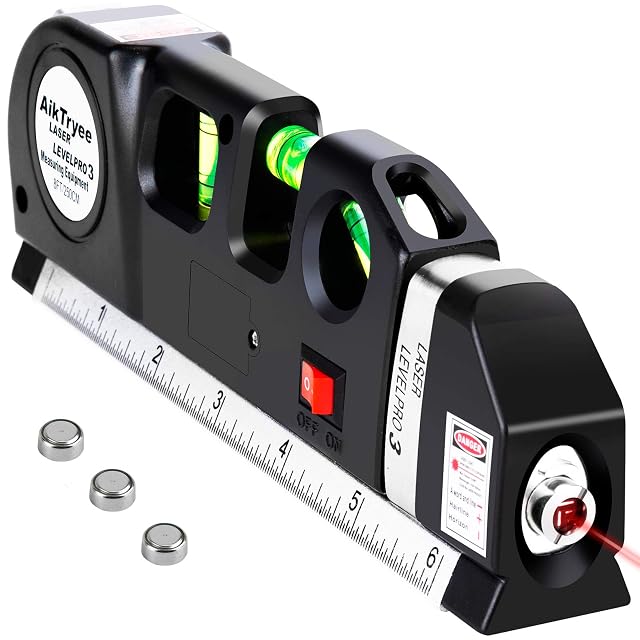
NOT self-leveling. Three bubble vials are stated — one level at 0°, one plumb at 90° and one at 45° — for determining the horizontal and vertical plane. A 45° vial is unusual and genuinely useful on a diagonal: it is the one angle nobody can judge by eye
Not published. No diode color, no wavelength, no laser class and no stated power. Of the six lasers on this shelf, this is one of only two that never say what color the line is — and this shelf's introduction opens on diode color as the visible difference between two lasers
One slider on the front switches between vertical line, horizontal line and cross, stated. A single front-mounted control is the right design on a tool held against a wall with one hand
NOT SELF-Leveling. Leveling is by bubble vial, and the angle is set on a dial reading from 15° to 75°. This shelf's introduction treats the self-leveling range as the specification that decides whether a tool is usable; on this laser there is none, and that is the design: a dial you set deliberately beats a pendulum you have to fight when the line is meant to be sloped
Three laser lines from one switch — horizontal, vertical and cross — at an exacting 90° to each other, stated. Class II with a maximum output under 1 mW, which is the lowest power on this shelf and the reason the stated reach is 30 ft rather than 100
No pulse mode, no stated accuracy per meter and no ingress rating. Built-in bubble vials are stated to ensure more accurate leveling, without a figure
Self-leveling within ±4°, with the line flashing continuously beyond that — stated, and Motovera adds that the flashing is a safety feature and not a malfunction. A manual mode locks the pendulum for sloped staircases and custom angles, and the laser then flashes once every five seconds as a reminder that the lines are no longer a level reference
A green laser diode stated 4× brighter than standard red, visible indoors to 100 ft, across a 110° projection angle, with FOUR brightness modes. Four settings is unique here: a green line at full power is dazzling in a dark room and barely enough in a sunlit one
A PULSE FUNCTION, stated — the only one on this shelf. This shelf's introduction lists it as the fifth thing to compare, and it is what makes a line laser usable in daylight: the beam is modulated so a receiver can pick it out of sunlight at a distance the eye cannot. This site carries a laser receiver shelf, and this is the only laser on this shelf a receiver will work with
What the models do not share, in measuring instruments
If price decides: AikTryee Manual cross-line laser with an 8 ft tape, at $10.
Highest Measuring mode in the table: Prexiso Manual cross-line laser, 30 ft, angle dial 15°–75° (NOT SELF-Leveling. Leveling is by bubble vial, and the angle is set on a dial reading from 15° to 75°. This shelf's introduction treats the self-leveling range as the specification that decides whether a tool is usable; on this laser there is none, and that is the design: a dial you set deliberately beats a pendulum you have to fight when the line is meant to be sloped).
This one’s price among measuring instruments
Details checked on October 8, 2026.
Who should pick this one, among measuring instruments
Tiling, carpentry and picture hanging indoors, where red is enough and the budget is twenty dollars
What buyers actually choose
Amazon reports what buyers took in the month before this page was last checked: at least 1,000.
The figure is a floor, rounded by Amazon, and read through Keepa — it says what buyers picked, not what a maker claims.
Sources
Specifications: the manufacturer sheet for measuring instruments and the matching Amazon product page. Prices and availability: Keepa. Every figure on this page names its source.
TEN DOLLARS, the cheapest laser on this shelf · NOT self-leveling: three bubbles at 0°, 90° and 45° · three line modes on one front slider · an 8 ft tape graduated to 1/32 in and 1 mm (0.04 in), the only tape here · no accuracy figure, no range, no ingress rating, no diode color
Ten dollars for three bubbles, three line modes and a tape — and not one published figure about the laser itself.
Best for: Hanging pictures and shelves at home, where ten dollars and a tape in the same hand is the whole requirement
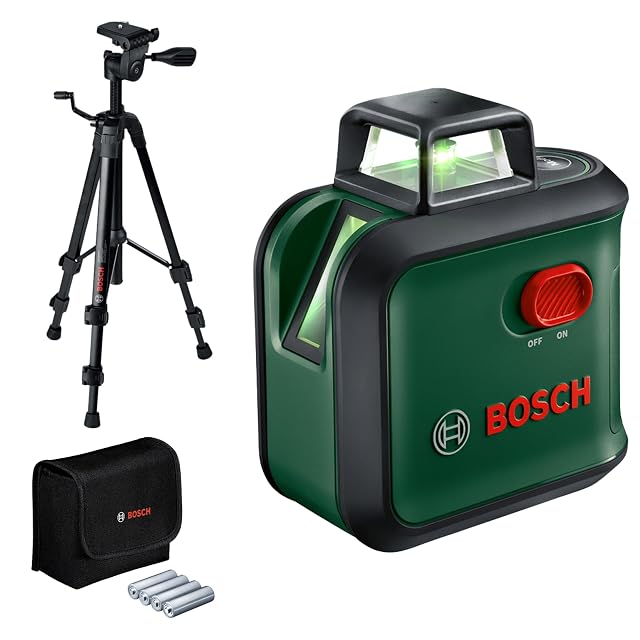
± 0.4 mm (0.02 in)/m stated · 1 × 360° horizontal + 2 vertical · plumb point · tripod included
The cheapest laser in this hub that publishes an accuracy figure: Bosch states ± 0.4 mm (0.02 in)/m for the lines and ± 1.0 mm (0.04 in)/m for the plumb point, with a TT 150 tripod in the box.
Best for: The first laser in this hub you can actually compare to another one, because it publishes the number that comparison needs.
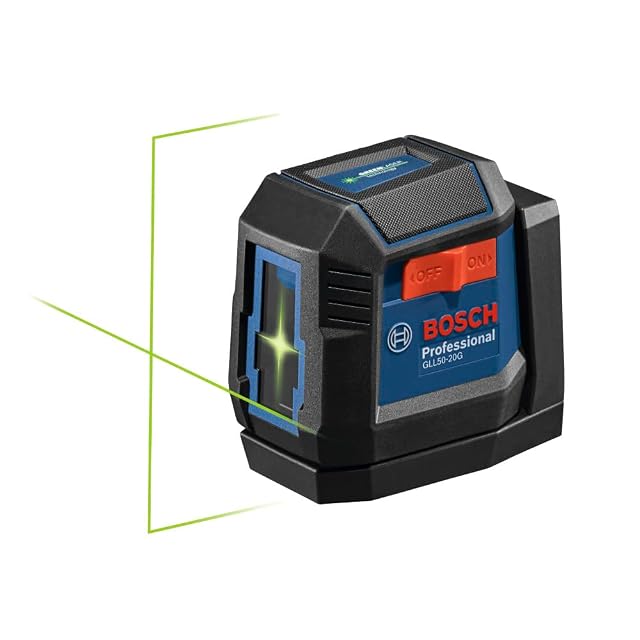
Sold as a GREEN beam up to 4× brighter than red — and the same page publishes 630–650 nm, which is RED · IP55, the highest rating here · Smart Pendulum self-leveling with NO range published · the title says 50 ft and the description 65 · the accuracy bullet says 5/16 in at 30 ft and the description 1/4 in · integrated magnetic mount · 2 AA or a 3.7 V Li-ion pack
The best-built laser on this shelf, on a page that contradicts itself three times — including about the color of its own beam.
Best for: A wet or dusty site where IP55 and a Bosch battery platform matter more than a tidy datasheet