Thermal cameras: which resolution number is the real one
A thermal camera listing usually carries two resolutions and only mentions one of them loudly. FLIR states 1440 × 1080 image and 80 × 60 thermal in the same paragraph; TOPDON states 320 × 240 derived from 160 × 120. The detector figure is the instrument; the other is a picture.
Three cameras, and the ranking follows the detector rather than the headline.
First: the only single figure
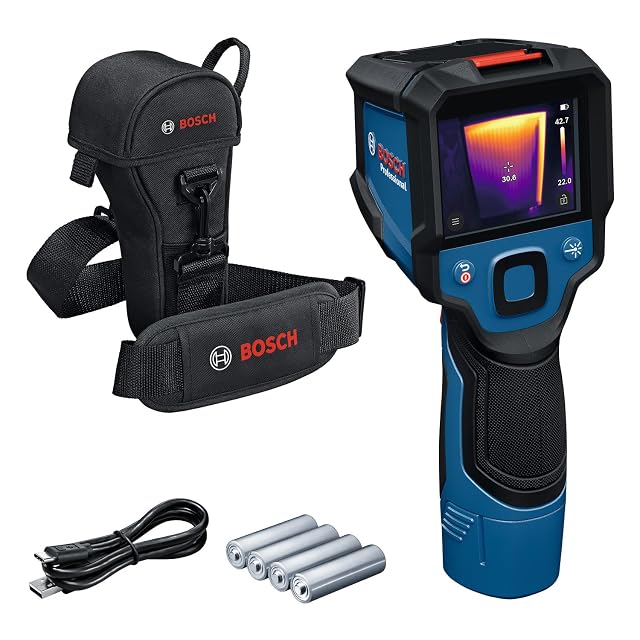
The Bosch GTC 12V-450-13 quotes 256 × 192 px and nothing else — no separate upscaled image number, which reads as a native detector specification. At 49,152 measured points it is two and a half times the TOPDON detector and ten times the FLIR ONE. It is also the only camera here with an ingress rating and a drop rating, and the only one that publishes no accuracy figure.
Second: the one that publishes its derivation
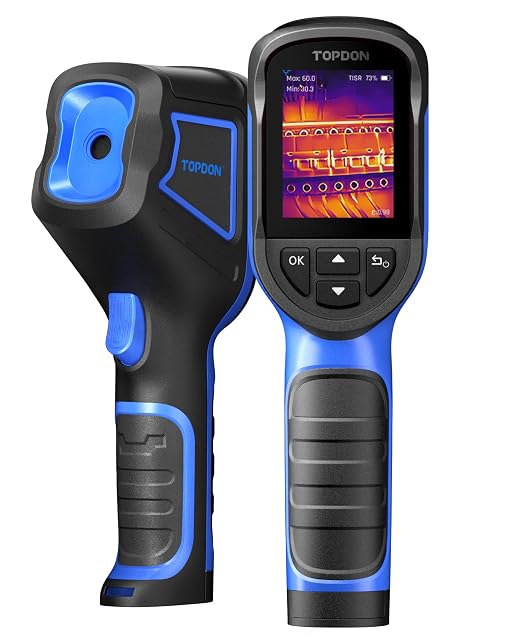
The TOPDON TC004 Mini states 320 × 240 from 160 × 120 — upscaling, published as upscaling. It states ± 2 °C (36 °F), the tightest accuracy in the hub, a −20 to 550 °C (-4 to 1022 °F) range, Wi-Fi, PC analysis and 14 hours of runtime. For work that has to end in a report rather than an impression, it is the practical choice.
Third: the honest entry point
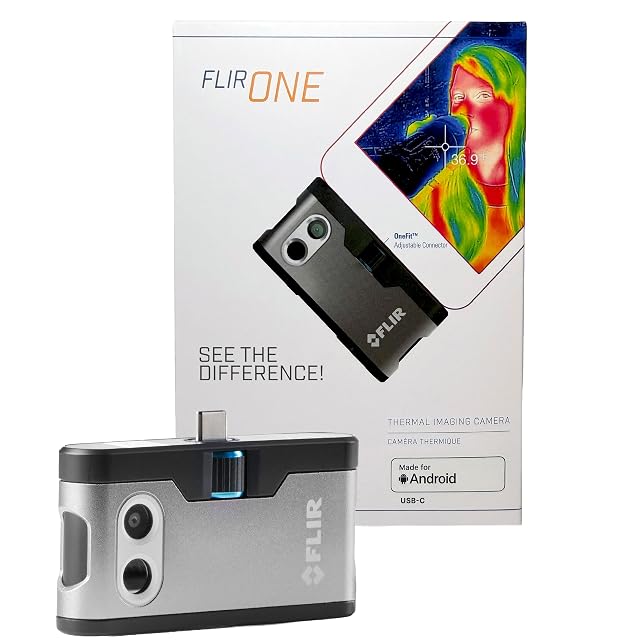
The FLIR ONE Gen 3 states 1440 × 1080 image and 80 × 60 thermal in the same sentence, and gives its accuracy with its conditions: ± 3 °C (37 °F) or ± 5% with the device between 15 and 35 °C (95 °F). It plugs into a phone. Four thousand eight hundred measured points is enough for the building-fabric problems most people buy a thermal camera for.
The rule to carry away
Read the smaller number. It is the instrument.
Which instrument does your work demand?
You want to find drafts and missing insulation
A modest sensor is enough, because you are looking at large areas with clear differences.
You want to inspect electrical panels
Resolution and temperature accuracy start to matter, and so does knowing what you are looking at.
You want to detect a leak under a floor
The camera shows temperature, not water. It suggests where to look; it does not confirm.
You are buying on a headline number
Check whether it is the detector's true resolution or an enhanced display figure.
Picking by the measurement
Finding heat loss
The commonest domestic use, and one that works with a modest sensor because the differences are large.
Underfloor heating and pipe runs
Where a thermal image shows layout clearly, which is genuinely useful before drilling or lifting.
Electrical inspection
Where a hot connection stands out, and where accuracy and interpretation both matter.
Moisture indications
Evaporation cools a surface, so damp can show as a cool patch. It is an indication, not a measurement of water.
The figures that settle accuracy accuracy
True detector resolution
The number of actual sensor pixels, not an interpolated or enhanced display figure. Marketing frequently quotes the larger number.
Thermal sensitivity
How small a temperature difference the camera can distinguish. For finding subtle differences this matters more than raw pixel count.
Emissivity and what it does
Different surfaces radiate differently, and shiny metal reads far colder than it is. Without allowing for this, the temperature numbers are wrong.
Field of view and distance
A small target seen from far away occupies too few pixels to be measured correctly, whatever the camera's specification.
Whether you need temperatures or patterns
Finding a draft needs a pattern. Certifying a temperature needs accuracy, emissivity settings and a controlled comparison.
Which tolerance for which work
Your use
What you need
What is oversold
Finding drafts
A modest sensor
High resolution
Pipe runs and underfloor
Any thermal camera
Temperature accuracy
Electrical inspection
Resolution and accuracy
Enhanced pixel counts
Any use
Understanding emissivity
The headline number
The errors that cost you
Buying on an enhanced resolution figure
Many cameras quote an upscaled image size rather than the detector's true pixel count. The second number is the one that determines what you can actually resolve.
Reading shiny surfaces as cold
Polished metal reflects rather than radiates and appears far colder than it is. This is emissivity, and it misleads every new user.
Measuring a small target from far away
If the target covers only a pixel or two, the reading averages it with its surroundings. Getting closer changes the answer entirely.
Treating a cool patch as proof of water
Evaporation cools surfaces, so damp often shows. So do drafts, thermal bridges and shade. The camera indicates where to investigate.
By the trade you are in
The homeowner
A modest camera to find drafts, missing insulation and pipe runs. Anything more is beyond what the use needs.
The tradesperson
True resolution and accuracy appropriate to the work, plus an understanding of emissivity.
The curious
Even a basic camera reveals a great deal about a house, provided its readings are treated as indications.
Calibration and how long accuracy holds
A thermal camera is a delicate sensor behind a lens made of an unusual material. The lens should never be cleaned like glass, and the camera needs time to stabilize when moved between temperatures before its readings settle.
Clean the lens only as the maker specifies; the coating is easily damaged.
Let the camera acclimatize when moving between very different temperatures.
Keep it out of direct sun, which affects both the sensor and the readings.
Store it in its case; the lens is the expensive part.
Safety
The camera itself is harmless; what it looks at often is not.
Never open an electrical panel to inspect it unless you are qualified to do so.
A thermal camera does not make live equipment safe to approach.
Do not use readings to make structural or safety decisions without proper investigation.
Beware of assuming a cool area is damp; confirm with an appropriate method.
256 × 192 px · −20 to +450 °C (842 °F) · IP54 · 2 m (7 ft) drop · dual power
A camera that quotes 256 × 192 with no upscaled figure beside it, in an IP54 body rated for a 2 m (7 ft) drop, running on a 12 V Li-ion pack or AA cells.
Best for: Site use, where the camera shares a bag with other tools and has to work on the first press.
160 × 120 detector, 320 × 240 displayed · −20 to 550 °C (-4 to 1022 °F) · ± 2 °C (36 °F) stated · Wi-Fi
A standalone thermal camera stating a 320 × 240 output produced by upscaling a 160 × 120 detector, with ± 2 °C (36 °F) accuracy, a −20 to 550 °C (-4 to 1022 °F) range and Wi-Fi to a PC.
Best for: Regular inspection work where images have to be reviewed and reported afterwards rather than glanced at.
A phone-attached thermal camera whose listing states both numbers plainly: an 80 × 60 thermal detector behind a 1440 × 1080 displayed image, with accuracy given as ± 3 °C (37 °F) or ± 5%.
Best for: A first thermal camera for home inspection, where finding the cold spot matters more than resolving it finely.
How do I tell the detector resolution from the image resolution?
The detector figure is the smaller one, and it is usually the one qualified by the words "thermal", "IR" or "from". If a listing gives only one number and it is large, assume it is the image and look for the detector figure in the technical data.
What can 80 × 60 actually find?
Large, high-contrast features: a missing insulation batt, a cold bridge, an overheating connection in an open box, a blocked radiator. What it will not do is resolve one small component among several in a crowded panel.
Does a thermal camera find damp?
It finds temperature differences, and evaporating moisture is often cooler — which is a hint, not a diagnosis. It does not see through walls, and it does not replace a moisture meter or a qualified assessment.
How much resolution do I need?
For drafts and insulation, surprisingly little, because the differences are large. For electrical inspection and small targets, true detector resolution starts to matter.
What is the difference between real and enhanced resolution?
Real resolution is the detector's pixel count; enhanced is an upscaled image. Only the first determines what the camera can actually resolve.
Why does shiny metal look cold?
It reflects rather than radiates, which is emissivity. Without accounting for it, the temperature reading on any polished surface is wrong.
Can a thermal camera find a water leak?
It can show cool patches where evaporation is happening, which suggests where to look. It does not detect water and it does not confirm a leak.
Does distance matter?
A great deal. A small target seen from far away occupies too few pixels to be measured correctly, and the reading averages in its surroundings.
Is thermal sensitivity more important than resolution?
For finding subtle differences, often yes. Resolution decides what you can see; sensitivity decides how small a difference is visible at all.
Targets, tripods and spares from the same aisle, at the price we noted. Check the thread matches the instrument you pick before ordering: it depends on the mount and the part number, which the listing states.
GP Extra Alkaline 9V · Instrument batteries — 9 V alkaline · eight-pack · G-TECH construction
Fieldpiece ST4 · Temperature probes — TWO type K channels, T1 / T2 / T1−T2 · −58 to 2000 °F (−50 to 1300 °C), the widest span on this shelf · WRAP-TAB BEADED thermocouples supplied · TWO front-face CALIBRATION POTS, the only adjustable instrument here · LED for a disengaged probe · rubber boot · magnetic hanger case · NO accuracy figure · $119 · $119
Klein Tools 69140 · Temperature probes — Type K · a PIPE CLAMP, a style the hub intro does not name · pipes 1/4 to 1-3/8 in · −4 to 212 °F (−20 to 100 °C) — the NARROWEST range on this shelf · ±2% stated · 40 in (102 cm) flexible lead · banana plug adapter SOLD SEPARATELY (Cat. No. 69146) · $27
The instruments above come from the catalog of this site. Specifications are the ones the manufacturer states and the ones on the Amazon listing; prices are the Keepa reading for the date below, and both change. Ranking uses declared specifications, stated strengths weighed against stated limits, and price. Nothing here has had its accuracy checked by us, and the page says as much.
Last checked on
Prices quoted in these summaries are dated readings. The live price is shown next to each product.
The tool we use ourselves
Chosen your tool? Now buy it at the right price.
Thermal cameras, line lasers and clamp meters swing by thirty dollars or more
across the
year, and the biggest "discounts" often land at prices the same model sold for six weeks
earlier.
UniverTrack tracks the real price history across retailers, spots fake
reductions, and alerts you when it is genuinely the moment to buy.
Real price historyBuy-now alertsAI buying assistant