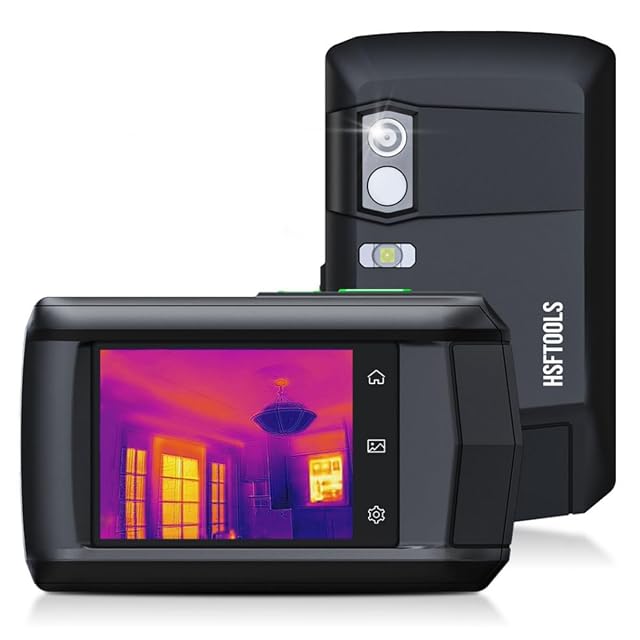
A standalone thermal camera stating a 320 × 240 output produced by upscaling a 160 × 120 detector, with ± 2 °C (36 °F) accuracy, a −20 to 550 °C (-4 to 1022 °F) range and Wi-Fi to a PC.
What the figures leave us with The tightest published accuracy here and a real reporting workflow. Read 160 × 120 as the instrument specification.
A standalone camera specified for the work that happens after the site visit.
What the manufacturer publishes
Sharp thermal images with TISR technology giving an improved resolution of 320 × 240 from a base of 160 × 120. Wi-Fi transmission to the TopInfrared app for live viewing and capture, with PC analysis, and 8 GB of onboard storage. A measuring range of −20 °C (-4 °F) to 550 °C (1022 °F) with an accuracy of ± 2 °C (36 °F) and a stated thermal sensitivity. Up to 14 hours of operation with automatic switch-off.
Reading the resolution honestly
The sentence contains both numbers and the word that connects them: 320 × 240 from 160 × 120. That is upscaling, stated as upscaling. The detector — 19,200 measured points — is the instrument specification, and it is four times what the FLIR ONE offers.
The part that separates it from a phone attachment
Onboard storage, Wi-Fi transfer and PC analysis mean the images become a report. A thermal survey that stays on a phone is a memory; one that lands in software with its temperature data intact is evidence you can compare against next year.
Availability
No such listing: the American Amazon shop answers the reference with a search box rather than a page.
Read from Keepa on the day this page was last revised; stock and price both move without notice.
What it has, and what it lacks
Strengths
States both numbers: 320 × 240 output derived from a 160 × 120 detector
Publishes ± 2 °C (36 °F) accuracy, matched but not beaten in this hub
A wide −20 °C (-4 °F) to 550 °C (1022 °F) measuring range
Wi-Fi to the TopInfrared app and PC analysis, with 8 GB of onboard storage
Up to 14 hours of stated runtime
Compromises
The 320 × 240 headline is upscaled — the detector is 160 × 120
No ingress rating stated, unlike the Bosch
Not found on the American market
Specifications
Amazon reference
B0H5WXM6BB (identical on 5 markets)
EAN
0810139304555
Display
160 × 120 detector, 320 × 240 displayed
Stated temperature range
−20 to 550 °C (-4 to 1022 °F)
Stated accuracy
± 2 °C (36 °F) stated
Connectivity and storage
Wi-Fi
What gets asked here
Is 160 × 120 enough?
It is four times the measured points of the FLIR ONE and two thirds of the Bosch. It resolves individual components in a distribution board, which the 80 × 60 detector does not.
What is TISR?
TOPDON's name for the upscaling that produces a 320 × 240 image from a 160 × 120 detector. The listing states the derivation openly, which is the right way to publish it.
Why does the 14-hour runtime matter?
A survey of a whole building is a day's work. A camera that needs charging halfway through it becomes a camera that gets used for spot checks only.
Our score
7.8/ 10
The tightest published accuracy here and a real reporting workflow. Read 160 × 120 as the instrument specification.
This one’s price among measuring instruments
A reference exists on these Amazon stores: France, Germany, Italy, Spain, United Kingdom. Listed is not the same as in stock — availability changes daily.
Details checked on August 31, 2026.
Who should pick this one, among measuring instruments
Regular inspection work where images have to be reviewed and reported afterwards rather than glanced at.
Amazon reports what buyers took in the month before this page was last checked: at least 100.
The figure is a floor, rounded by Amazon, and read through Keepa — it says what buyers picked, not what a maker claims.
Sources
Specifications: the manufacturer sheet for measuring instruments and the matching Amazon product page. Prices and availability: Keepa. Every figure on this page names its source.
256 × 192 px · −20 to +450 °C (842 °F) · IP54 · 2 m (7 ft) drop · dual power
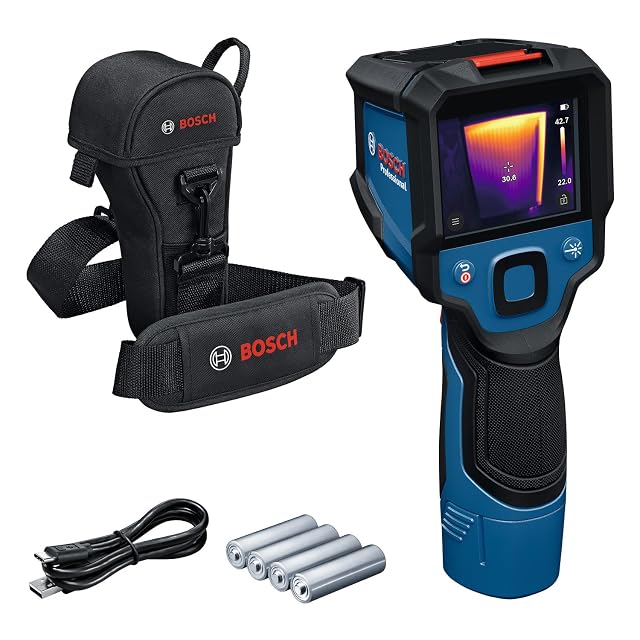
A camera that quotes 256 × 192 with no upscaled figure beside it, in an IP54 body rated for a 2 m (7 ft) drop, running on a 12 V Li-ion pack or AA cells.
Best for: Site use, where the camera shares a bag with other tools and has to work on the first press.
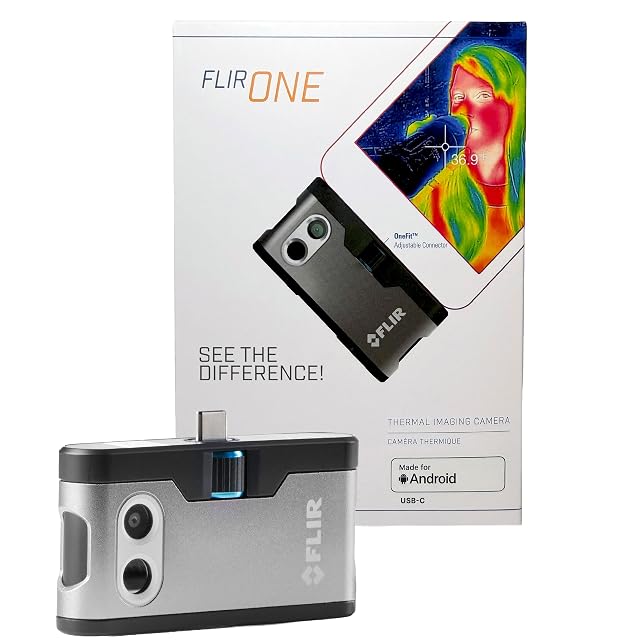
A phone-attached thermal camera whose listing states both numbers plainly: an 80 × 60 thermal detector behind a 1440 × 1080 displayed image, with accuracy given as ± 3 °C (37 °F) or ± 5%.
Best for: A first thermal camera for home inspection, where finding the cold spot matters more than resolving it finely.
256 × 192 DETECTOR stated, upscaled to 640 × 480 · VOx · under 40 mK, 0.04 °C (32 °F) · −4 to 752 °F (−20 to 400 °C) · max(±3.6 °F, ±2%) · emissivity AND distance adjustable · 3.5 in TOUCHSCREEN, the largest here · 8 MP visible cam — four times the Raythink and the F2VW · 5 image modes, 8 palettes · Wi-Fi + PC software with 3D plotting · 16 GB / 60,000 images / 54 h video · 4 h battery · IP54, 6.6 ft · $479
The most expensive camera on this shelf: the same 256 × 192 detector as the F2VW with a bigger touchscreen, four times the visible camera, and a lower temperature ceiling.
Best for: Reporting work, where the images go into a document and the 8 MP visible shot is half the evidence