What the maker puts in writing
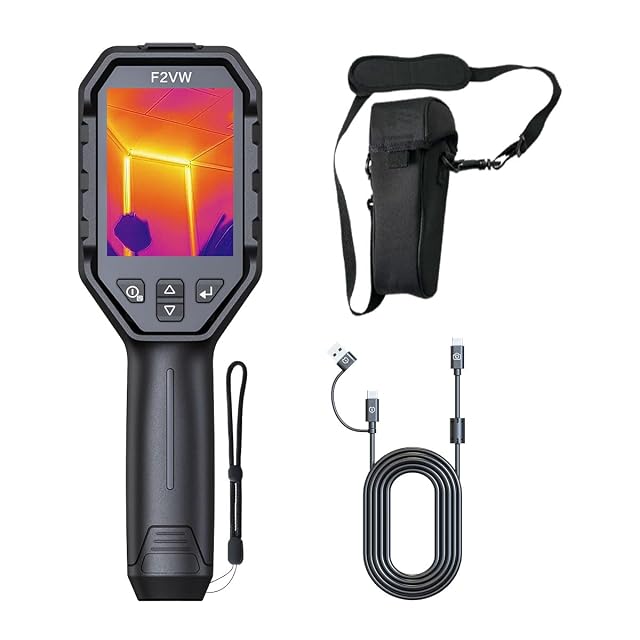
- “elevate the base 256×192 detector resolution to an stunning 640×480 output”
- “a high thermal sensitivity of <40mK” · “detect temperature differentials as small as 0.04℃” · “an advanced VOx detector”
- “a wide temperature range of -4℉ to 752℉”
- “temperature readings discrepancy is within max(±3.6°F, ±2%)”
- “change emissivity settings based on specific materials and adjust the distance to objects”
- “3.5” touchscreen at 25 Hz frame rate” · 8 MP visual cam · 5 image modes · 8 palettes
- “built-in 16GB eMMC storage that can store up to 60,000 images and 54 hours of recorded MP4 videos”
- “rechargeable lithium-ion battery provides up to 4 hours” · “6.6ft drop test and IP54” · $479
NO emissivity range. No native-detector ambiguity, for once.
The same detector as the cheaper one
Two hundred and fifty-six by a hundred and ninety-two, stated.
Identical to the F2VW at $439. Identical to the published Bosch. Two and a half
times the 19,200 pixels both Kleins publish.
So the forty dollars between the two HSFTOOLS cameras buys nothing in the sensor.
It buys the screen, the camera and the storage
Three and a half inches of touchscreen, phone-style, the largest here.
EIGHT megapixels of visible camera, against two on the F2VW and two on the
Raythink.
Sixteen gigabytes — sixty thousand images, fifty-four hours of video — against
eight on the Raythink.
Five image modes instead of four, with Blending added. And PC software with 3D
plotting.
Which matters because a thermal image is not evidence on its own
A blob of color does not say which board, which room, or what the label on the
breaker read.
The visible shot taken at the same instant from the same place is the other half
of the finding.
Two megapixels is readable on a phone. Eight lets somebody read the printed rating
on a terminal block in the report.
And it gives up a hundred and fifty degrees
F2VW, $439: −4 to 1022 ℉. Five hundred and fifty Celsius.
P2W, $479: −4 to 752 ℉. Four hundred.
Same detector, same sensitivity, same accuracy form, same corrections. Forty
dollars more, a hundred and fifty degrees less.
Nothing on either listing explains it. If the work involves a flue, a kiln or an
exhaust, the cheaper camera is the one that reaches it.
Four hours
The shortest runtime published on this shelf.
The $199.99 Raythink publishes ten.
Auto power-off, sleep and brightness control stretch four hours a long way,
because an inspection camera is not on continuously. But a camera that dies at two
in the afternoon, an hour from the office, is a return visit.
It charges over USB. A power bank solves it.
Emissivity AND distance, both adjustable.
A quarter-inch tripod hole, for the one job a hand cannot do: same framing, before
and after.
An LED torch for the cupboard.
And a VOx detector, named — which only this pair states on this shelf.
Availability
On sale at around 479 € on the American Amazon store at the time of checking.
Prices and availability are what Keepa reported on the date this page was updated; both move.
Prices quoted in this text were read on 8 October 2026. The live price is at the top of the page.