What the figures leave us with The one to buy at this price. A published figure, an aluminum body, and four faces you can put down on.
Thirteen euros, and the specification that the tool next to it omits.
What the manufacturer publishes
MEMS technology reaching an accuracy of ± 0.2°, with four sides usable as a measuring reference, over a range of 0–90°. A powerful magnetic base stated to hold reliably on metal profiles, pipes and saw blades. A large LCD with automatic backlight and a data-hold function. A high-quality aluminum housing, stated as splash-protected and robust for construction use.
Why the hold function is not a gimmick
An angle gauge is often placed where it cannot be read — under a saw table, inside a frame, on the far face of a beam. Hold freezes the reading so the tool can be taken out and looked at. Without it, half the measurements a gauge is bought for cannot be taken at all.
The magnet and its limits
A strong base on a steel section is what turns this into a hands-free instrument. On aluminum, stainless of the wrong grade, or thin sheet, the magnet does far less — and the tool becomes something you have to hold still, which is exactly when a hold function matters.
Availability
Catalogued and unsold: the American Amazon shop lists the reference with nobody behind it.
Read from Keepa on the day this page was last revised; stock and price both move without notice.
What it has, and what it lacks
Strengths
States ± 0.2° accuracy over a 0–90° range, using MEMS sensing
All four faces usable as a reference, so the tool does not have to be turned to suit the work
An aluminum housing, stated as splash-protected and robust for site use
Backlit LCD with a data-hold function for readings taken out of sight
Compromises
A 0–90° range rather than the 4 × 90° of the Neoteck and RISEPRO
No V-groove for pipes, unlike the Klein Tools
Not found on the American market
Specifications
Amazon reference
B0DJ921B4D (identical on 6 markets)
EAN
4895232024964
Stated accuracy
± 0.2° stated
Angle range
0–90°
Reference and mounting
four reference faces
Material
aluminum, splash-proof
What gets asked here
What is MEMS sensing?
A micro-machined accelerometer used as the tilt sensor. Mcbazel states MEMS technology reaching ± 0.2°. It is the standard technology in this class of tool.
Why do four reference faces matter?
A gauge with one reference face has to be placed a particular way up. With four, it can be laid on whichever face fits the work, which on a bracket or inside a frame is often the only face available.
Is 0–90° enough?
For setting blades, brackets and mitres, yes. For measuring a slope that passes through the vertical, the 4 × 90° gauges here read continuously through all four quadrants.
Our score
8.1/ 10
The one to buy at this price. A published figure, an aluminum body, and four faces you can put down on.
This one’s price among measuring instruments
A reference exists on these Amazon stores: France, Germany, Italy, Spain, United Kingdom, United States. Listed is not the same as in stock — availability changes daily.
Details checked on August 31, 2026.
Who should pick this one, among measuring instruments
The value pick: a published figure, a metal housing and four reference faces for thirteen euros.
Amazon reports what buyers took in the month before this page was last checked: at least 50.
The figure is a floor, rounded by Amazon, and read through Keepa — it says what buyers picked, not what a maker claims.
Sources
Specifications: the manufacturer sheet for measuring instruments and the matching Amazon product page. Prices and availability: Keepa. Every figure on this page names its source.
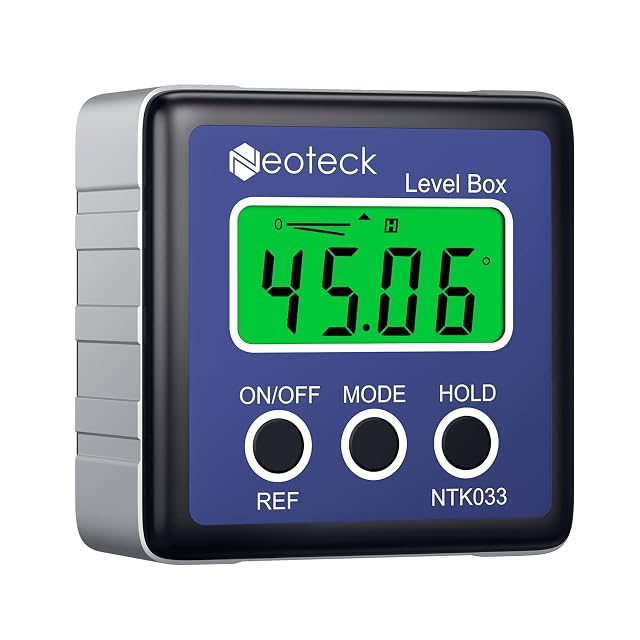
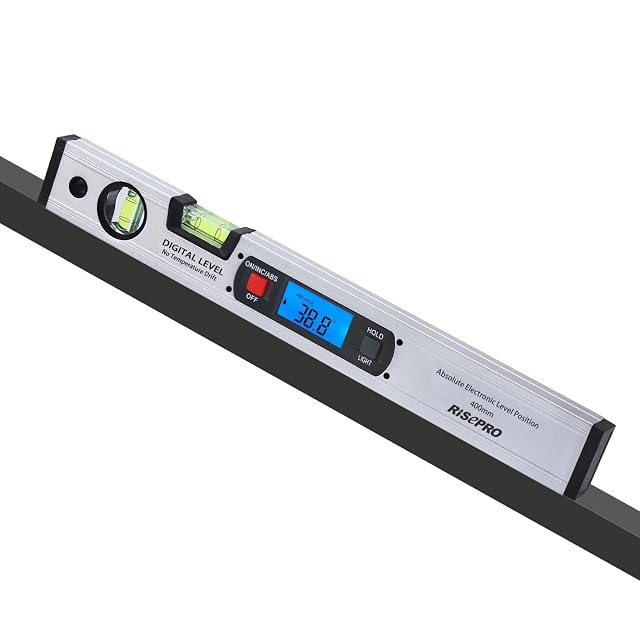
4 × 90° (360°) · four magnets · absolute and relative modes · backlit
A 360° angle gauge with four base magnets and both absolute and relative measuring modes — the second mode being the one most angle work actually needs.
Best for: Work that alternates between absolute slopes and relative angles without changing tools.
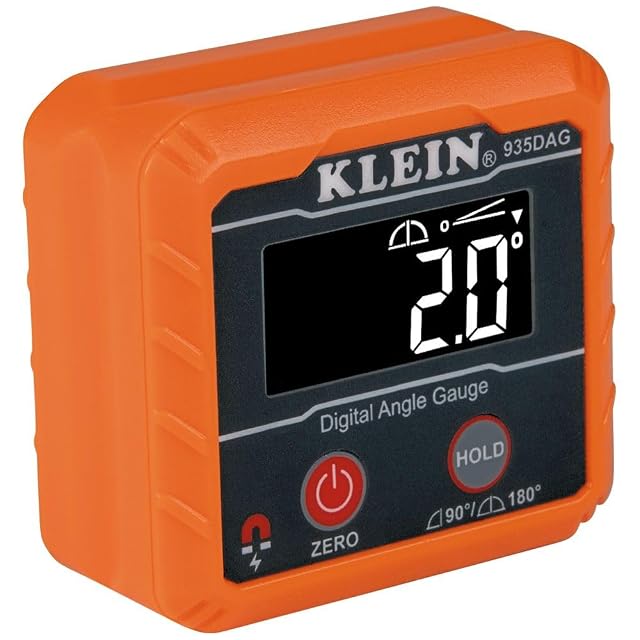
0–90° and 0–180° · magnetic base · V-groove for pipe and conduit
A trade angle gauge with dual 0–90° and 0–180° ranges and a V-groove machined around the base, so it sits on pipe and conduit instead of rocking on them.
Best for: Pipe and conduit bending, where the tool has to sit on a cylinder and stay there.