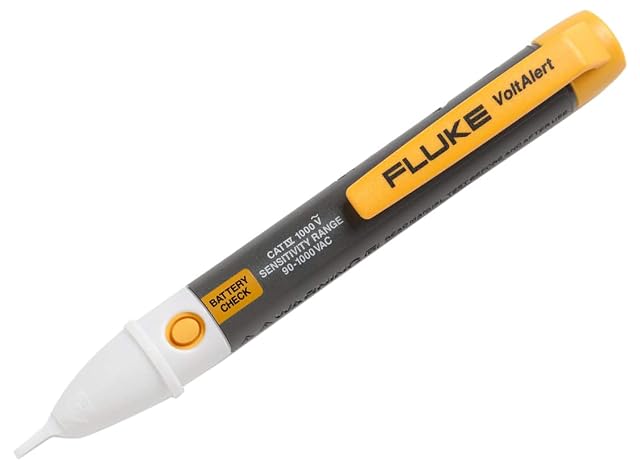
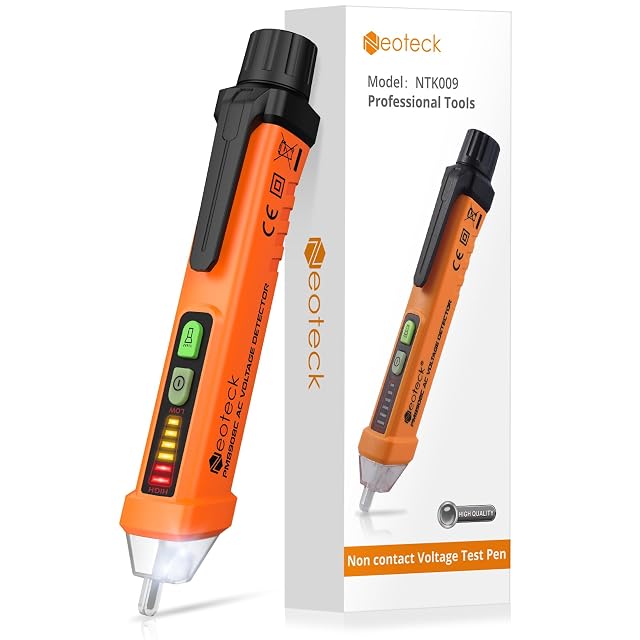
What the figures leave us with A plain, well-scoped trade detector. Nothing adjustable, nothing rated on the page, and a clear list of what it is for.
A detector that says precisely which jobs it is for.
What the manufacturer publishes
Time-saving voltage checking by non-contact measurement. A wide range of 90 to 1000 V AC. Stated uses: detecting and locating live conductors, cable interruptions and breaks, blown fuses and defective components. Single-pole operation.
The stated use list is the specification
Most pens describe a range and stop. Listing the faults the tool is meant to find is more useful, because it tells you the intended technique: this is a tool for following a circuit until the signal changes, not just for checking whether a socket is live.
Where it is deliberately deaf
Nothing under 90 V registers. On a domestic or commercial mains job that is a feature — no false alarms from data and control wiring. On anything with extra-low-voltage circuits, it is a blind spot, and the 12 V pens in this hub cover that ground instead.
Availability
Catalogued and unsold: the American Amazon shop lists the reference with nobody behind it.
Read from Keepa on the day this page was last revised; stock and price both move without notice.
What it has, and what it lacks
Strengths
A wide 90 to 1000 V AC range from a hand-tool maker with a catalog reference
Stated uses are specific: live conductors, cable interruptions and breaks, blown fuses, defective components
On sale across all six markets
Fast checking without contact, which is the entire point of the format
Compromises
No measurement category published
Does not detect below 90 V, the narrowest low-end here
No sensitivity adjustment and no vibration alert
Specifications
Amazon reference
B084HM35J9 (identical on 6 markets)
EAN
4010995437985
Voltage measurement
90–1000 V AC
Construction and safety
single-pole
Fuse
finds breaks, blown fuses and faults
What gets asked here
Why does the range start at 90 V?
It ignores everything below mains voltage, which makes it quieter around control and signal wiring. It also means it will not find a 24 V or 48 V circuit at all.
How does it find a blown fuse?
By following the conductor: voltage present on one side of the fuse holder and absent on the other localizes the break. Wiha lists this among the stated uses.
Does Wiha state a category?
Not in this listing. The two PeakTech pens in this hub do.
Our score
7.8/ 10
A plain, well-scoped trade detector. Nothing adjustable, nothing rated on the page, and a clear list of what it is for.
This one’s price among measuring instruments
A reference exists on these Amazon stores: France, Germany, Italy, Spain, United Kingdom, United States. Listed is not the same as in stock — availability changes daily.
Details checked on August 31, 2026.
Who should pick this one, among measuring instruments
A trade pocket detector for mains work, where nothing below 90 V is in scope.
What buyers actually choose
Amazon reports what buyers took in the month before this page was last checked: at least 50.
The figure is a floor, rounded by Amazon, and read through Keepa — it says what buyers picked, not what a maker claims.
Sources
Specifications: the manufacturer sheet for measuring instruments and the matching Amazon product page. Prices and availability: Keepa. Every figure on this page names its source.
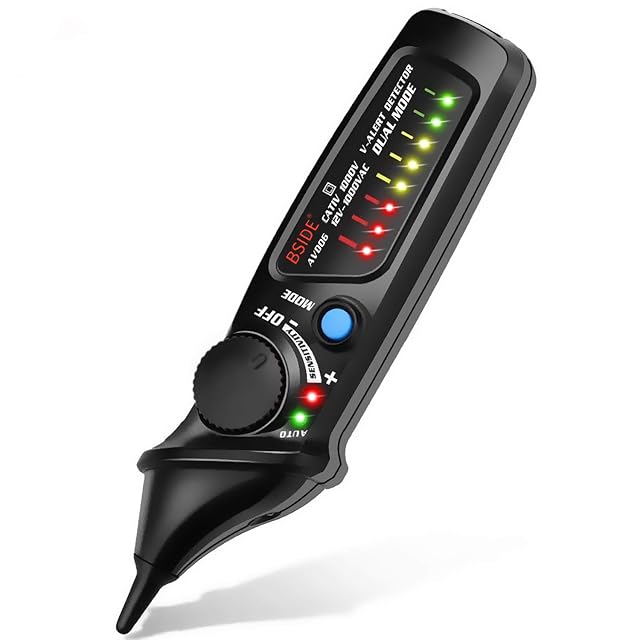
12–1000 V AC · auto and manual modes · stepless sensitivity · 8 LEDs in 3 colors
A detector with continuously adjustable sensitivity and an eight-LED, three-color strength display, so field strength is read as a scale rather than as a yes or no.
Best for: Picking one live conductor out of several, where a single-threshold pen lights up on all of them.