What the figures leave us with The dependable one. No display, no battery, no state in which it looks fine and is not.
The simplest instrument in this hub, and the argument for simplicity.
What the manufacturer publishes
For fast checking of Schuko sockets, entirely without batteries. A test button that trips a 30 mA RCD directly.
Why battery-free keeps appearing on this site
It is the same argument as the two-pole voltage testers above: an instrument that draws its indication from the circuit under test has no state in which it appears dead because it is dead. For a tool used a few times a year — which is exactly how a socket tester is used — that removes the most likely failure by construction.
What you give up
No number. The LCD testers in this hub read the supply voltage and quantify leakage, and this does neither. It answers the wiring question and the RCD question, which are the two questions socket testers exist for.
Availability
No such listing: the American Amazon shop answers the reference with a search box rather than a page.
Read from Keepa on the day this page was last revised; stock and price both move without notice.
What it has, and what it lacks
Strengths
Battery-free — the tester is always ready, which is the whole argument for this format
Trips a 30 mA RCD directly from the test button, with the current rating stated
Fast checking of Schuko sockets
Nothing to fail electronically
Compromises
No voltage display: it indicates a pattern, not a number
No measurement category published
Not found on the British or American markets
Specifications
Amazon reference
B0GVP4NMS6 (identical on 4 markets)
EAN
9120037337106
Power
Battery-free
Faults detected
Schuko sockets
Functions
trips a 30 mA RCD from a test button
What gets asked here
How does a battery-free tester work?
It draws the current for its indicators from the socket it is testing. That is why it cannot go flat, and also why it cannot display a voltage — there is no measuring circuit, only indication.
What does 30 mA mean in the RCD test?
It is the residual current the test button injects, matching the rating of the common domestic RCD. PANCONTROL states the button trips a 30 mA device directly.
Is a pattern enough?
For finding reversed conductors and a missing earth, yes — that is what socket testers were invented for. For knowing whether the supply is sagging, no, and the LCD testers in this hub cover that.
Our score
7.8/ 10
The dependable one. No display, no battery, no state in which it looks fine and is not.
This one’s price among measuring instruments
A reference exists on these Amazon stores: France, Germany, Italy, Spain. Listed is not the same as in stock — availability changes daily.
Details checked on August 31, 2026.
Who should pick this one, among measuring instruments
The tester that lives in the bag for a year and works when you finally reach for it.
Sources
Specifications: the manufacturer sheet for measuring instruments and the matching Amazon product page. Prices and availability: Keepa. Every figure on this page names its source.
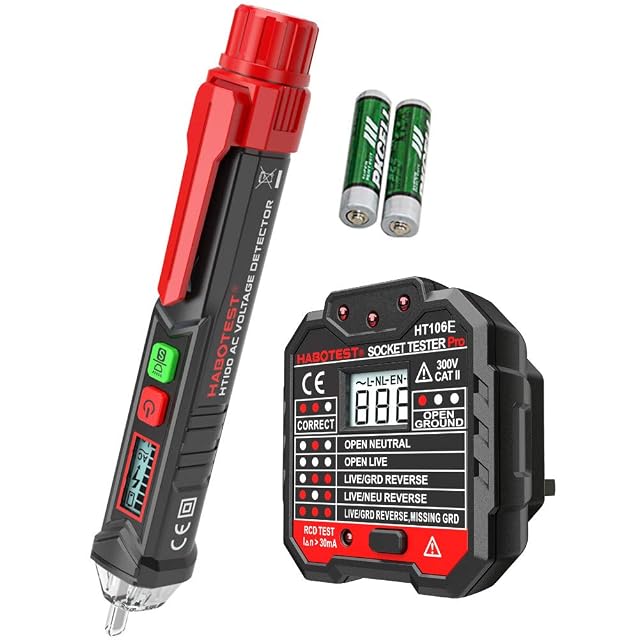
Socket tester with RCD trip · plus a 12–1000 V contactless pen · auto power-off
A two-piece kit: a socket tester with RCD trip function and a separate non-contact voltage pen covering 12 to 1000 V, with automatic power-off after three minutes.
Best for: Equipping someone from nothing, where owning both tools matters more than owning the better one of each.
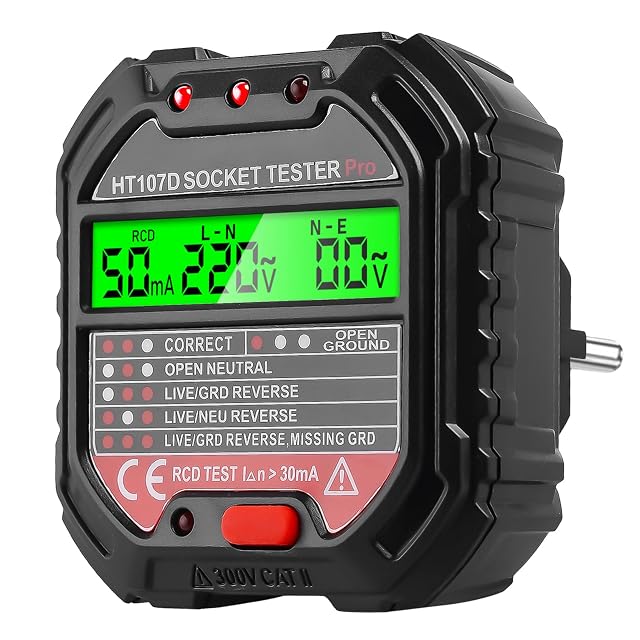
CAT II 300 V stated · six fault types · six LEDs · one-button RCD test
A socket tester stating CAT II 300 V — the only socket tester here that publishes a category — with six LED indications and a one-button RCD trip test.
Best for: The socket tester to buy if you want to know where the instrument is rated to be used.