It stands up on its own, which is what a tape cannot do · review
Stanley Wooden folding rule, 2 m (7 ft) review
The cheapest folding rule here and the one with the most stated about its construction: multi-dip lacquer, a UV protective film, concealed rivets, hardened steel springs, milled joint plates and brass joints, marked to EC accuracy class III.
What the figures leave us with The construction is stated in more detail than rules costing four times as much. Buy the 3 m (10 ft) version of something else if you build; buy this if you make.
Four euros, and the listing still says what the joints are made of.
What the manufacturer publishes
A multi-dip lacquered, weather-resistant surface with a UV protective film. Abrasion and climate resistance. Concealed rivets, hardened steel springs, milled joint plates and brass joints. EC accuracy class III.
Why the joint specification is the specification
The scale on a folding rule is printed once and, protected by lacquer and film, stays printed. The joints are mechanical and wear. A rule whose joints have gone slack folds, unfolds, and then sags in the middle when held out — losing precisely the rigidity that made it a folding rule instead of a tape. Brass against steel springs is the durable construction, and it is what Stanley states here.
Class III, honestly
Three EC classes exist and this is the loosest. In practice, for a rule read to the millimeter against a pencil line, the class is rarely the limiting factor — the pencil is. It becomes relevant when the rule is used as a reference to check something else, which is what class I rules are for.
Availability
Read on the day this page was built: $24 at the American Amazon shop.
Read from Keepa on the day this page was last revised; stock and price both move without notice.
Prices quoted in this text were read on 31 August 2026. The live price is at the top of the page.
What it has, and what it lacks
Strengths
Carries the EC accuracy class III marking, stated by Stanley
Brass joints with hardened steel springs and milled joint plates — the parts that decide whether it still stands straight in a year
Multi-dip lacquered and weather resistant, with a UV protective film over the scale
The cheapest rule here by a wide margin
Compromises
Two meters, where three is the more useful length for building work
No angle scale, unlike the PRESCH and Stabila here
Class III is the loosest of the three EC classes
Specifications
Amazon reference
B003BUBK0U (identical on 6 markets)
EAN
3253560354589
Stated dimension or range
2 m (7 ft) beech
EC accuracy class
EC class III
Probe and body
brass joints
Material
UV-protected
What gets asked here
What does EC accuracy class III mean?
It is a marking the manufacturer applies, describing the permitted deviation of the graduations. Class I is the tightest and class III the loosest. Stanley marks this rule class III. We report the marking as a manufacturer statement; this site is not a verification body.
Why do brass joints matter?
The joints are what a folding rule fails at. A rule with slack joints will not hold a straight line unsupported, which is the one thing it does that a tape cannot. Stanley states brass joints, hardened steel springs and milled joint plates.
Is 2 m (7 ft) enough?
For furniture, joinery and interior work, yes. For anything at building scale, 3 m (10 ft) is the standard length, and both the PRESCH and Meister rules here are 3 m (10 ft).
Our score
7.4/ 10
The construction is stated in more detail than rules costing four times as much. Buy the 3 m (10 ft) version of something else if you build; buy this if you make.
This one’s price among measuring instruments
A reference exists on these Amazon stores: France, Germany, Italy, Spain, United Kingdom, United States. Listed is not the same as in stock — availability changes daily.
Details checked on August 31, 2026.
Who should pick this one, among measuring instruments
A first folding rule, or the third one to leave in a different bag.
Accessories stated to fit this instrument
Listed because the accessory names this instrument itself.
Amazon reports what buyers took in the month before this page was last checked: at least 2,000.
The figure is a floor, rounded by Amazon, and read through Keepa — it says what buyers picked, not what a maker claims.
Sources
Specifications: the manufacturer sheet for measuring instruments and the matching Amazon product page. Prices and availability: Keepa. Every figure on this page names its source.
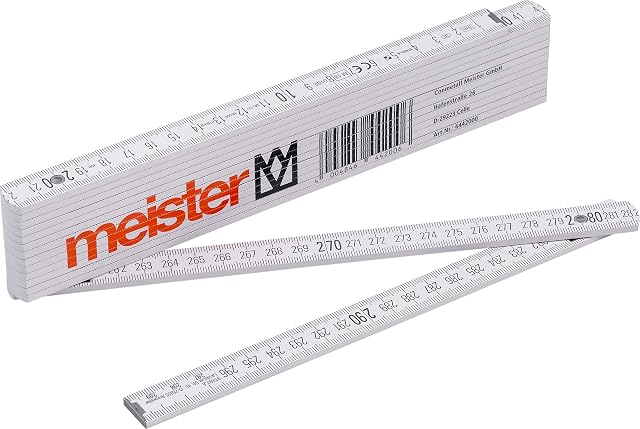
3 m (10 ft) beech · 15 segments · EC class III · extra-large tens
Three meters of beech in fifteen segments, marked to EC class III, with extra-large tens figures for reading at arm's length and a double scale along both edges.
Best for: The default building-site rule: three meters, legible, and cheap enough to replace without thinking.
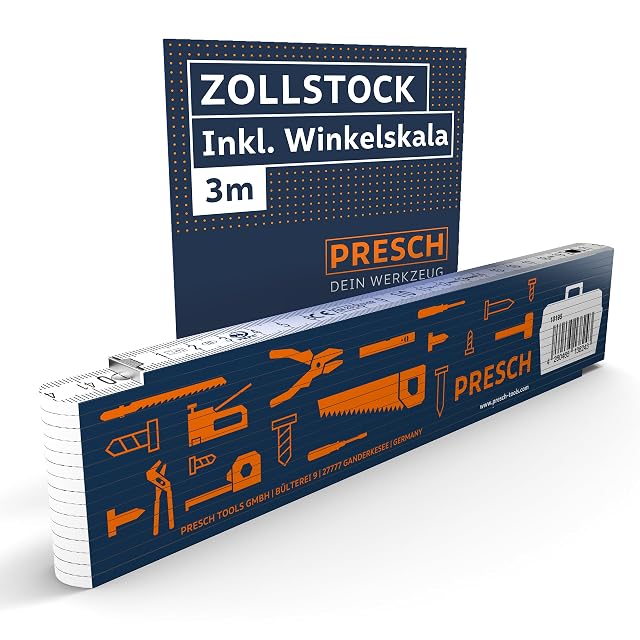
3 m (10 ft) beech · EC class III · integrated angle scale
A 3 m (10 ft) beech rule with an angle scale printed into the joints, so it marks and sets angles as well as lengths — the one function a plain rule cannot do at all.
Best for: Roofing, joinery and anything where the question is what angle, not just how long.
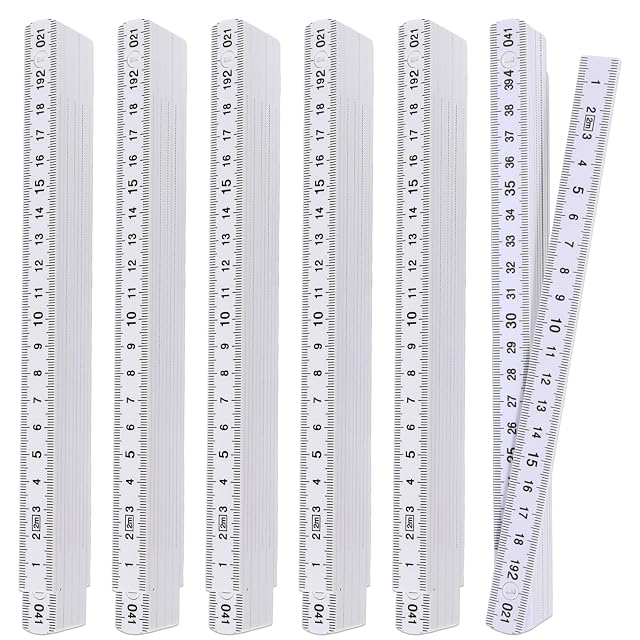
Five rules · 2 m (7 ft) each · ABS joints, PC body · folds to 230 mm (9.06 in)
Five 2 m (7 ft) plastic rules in one pack: a PC body on ABS connectors, ten segments folding to 230 mm (9.06 in), in white with a black scale. The set to buy when rules keep disappearing.
Best for: A workshop, a van and a shed each keeping their own rule, at the price of one wooden one.