Detection depth is stated per material, never as one number · review
EXTSUD Wall scanner, five modes review
A five-mode wall scanner covering wood, metal and live AC cables, stated to work on lath, wallpaper, wooden floors, acoustic ceilings and painted walls.
What the figures leave us with Names its surfaces and not its depths. The Technoline costs less and tells you how far it sees.
A capable scanner with the central specification absent.
What the manufacturer publishes
Five easily switchable detection modes with a clear, legible display, described as user-friendly. Fast and precise detection of wood, metal and AC power cables in walls, floors and ceilings. Stated to work reliably on lath, wallpaper, wooden floors, sound-insulated ceilings and painted walls. Positioned as protection against hazards when installing televisions, cupboards or garage shelving.
What naming the surfaces is worth
It is more useful than it looks. Wall scanners are defeated by construction, not by mode count: foil-backed board, metal mesh, damp plaster. A maker that lists the finishes it expects to work on is telling you where its calibration was aimed.
And what is still missing
No depths. Every one of these detectors is limited by how far it sees into a specific material, and this listing does not say for any of them. Treat every reading as an indication and follow the manufacturer instructions before drilling.
Availability
Read on the day this page was built: $48 at the American Amazon shop.
Read from Keepa on the day this page was last revised; stock and price both move without notice.
Prices quoted in this text were read on 31 August 2026. The live price is at the top of the page.
What it has, and what it lacks
Strengths
Five switchable detection modes with a clear display
The listing names the surfaces it is stated to work on, which is more practical than a mode list
Detects wood, metal and AC cables in walls, floors and ceilings
On sale across all six markets
Compromises
No detection depths published at all — the specification that decides whether it can find what you are looking for
No ingress rating
Five modes without depths is a longer list saying less than the Technoline's four
Specifications
Amazon reference
B0D4D8LWDB (identical on 6 markets)
EAN
0762763038408
Functions
Five detection modes
Probe and body
wood, metal and AC cable
Measuring mode
works through several wall finishes
What gets asked here
What depths does EXTSUD state?
None. The listing describes what the detector finds and on which surfaces, and gives no depth for any material. The Technoline in this hub publishes four depths; this publishes none.
Do five modes beat four?
Not by itself. Modes describe what the tool distinguishes; depths describe whether it can reach. Without the second, the mode count is a list rather than a specification.
What surfaces does it claim?
Lath, wallpaper, wooden floors, sound-insulated ceilings and painted walls, per the maker. Naming them is genuinely useful, because wall construction is what defeats these tools.
Our score
7.4/ 10
Names its surfaces and not its depths. The Technoline costs less and tells you how far it sees.
This one’s price among measuring instruments
A reference exists on these Amazon stores: France, Germany, Italy, Spain, United Kingdom, United States. Listed is not the same as in stock — availability changes daily.
Details checked on August 31, 2026.
Who should pick this one, among measuring instruments
General household scanning where the question is "is there anything there" rather than "how deep".
What buyers actually choose
Amazon reports what buyers took in the month before this page was last checked: at least 200.
The figure is a floor, rounded by Amazon, and read through Keepa — it says what buyers picked, not what a maker claims.
Sources
Specifications: the manufacturer sheet for measuring instruments and the matching Amazon product page. Prices and availability: Keepa. Every figure on this page names its source.
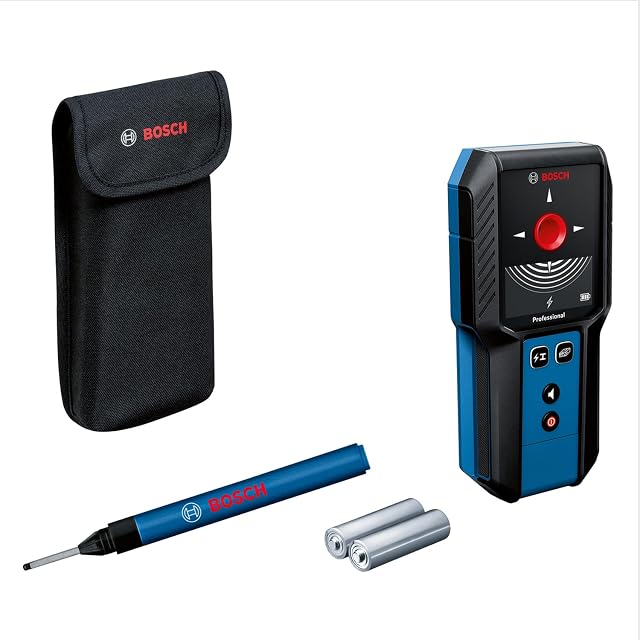
Metal, live cable and timber · three-color LED ring · center indication · IP54
A site-rated scanner that identifies which material it has found and rings the marking hole with a three-color LED — red on the object, yellow approaching, in an IP54 rubber housing.
Best for: Repeated drilling on site, where finding the center of the stud quickly matters more than reading a depth.
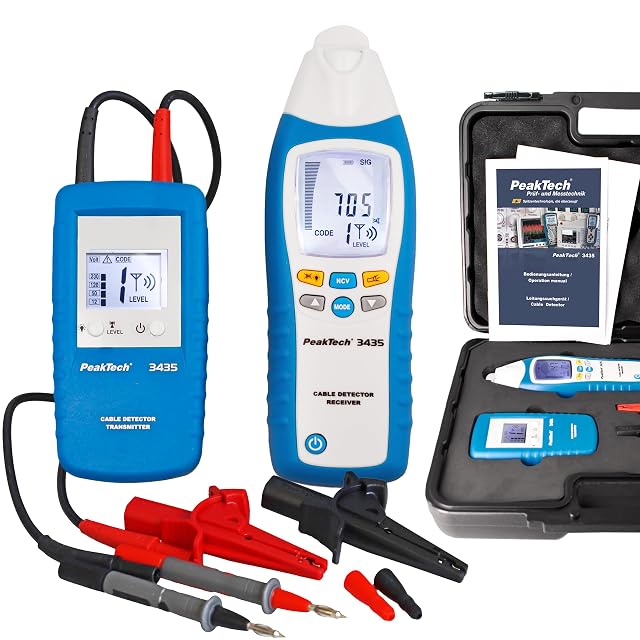
Transmitter plus receiver · up to 2 m (7 ft) reception depth · 7 channels · live and dead cables
Not a wall scanner but a cable tracer: a transmitter injects a signal into a conductor and a receiver follows it, to a stated depth of 2 m (7 ft), on live or dead cables.
Best for: Following one specific cable through a building, which no wall scanner can do at all.
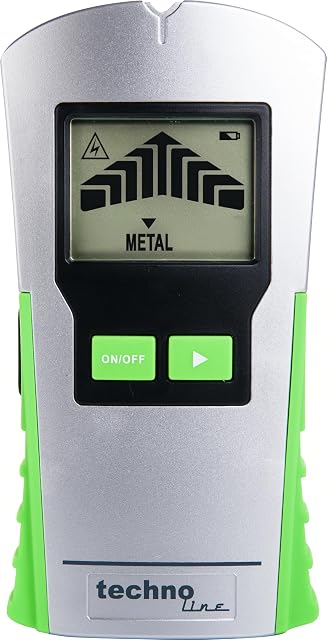
Wood 19 mm (0.75 in) · metal 30 mm (1.18 in) · deep 38 mm (1.50 in) · live cable 50 mm (1.97 in) at 230 V
The only detector here that publishes a depth for every material it claims: wood to 19 mm (0.75 in), metal to 30 mm (1.18 in), deep scan to 38 mm (1.50 in) and live cable to 50 mm (1.97 in) at 230 V.
Best for: Anyone who wants to know what the depth figure means before trusting it.