The procedure
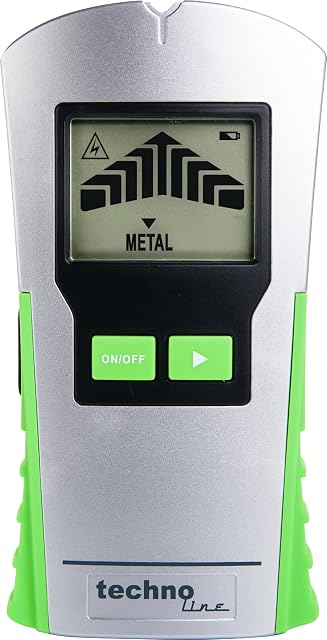
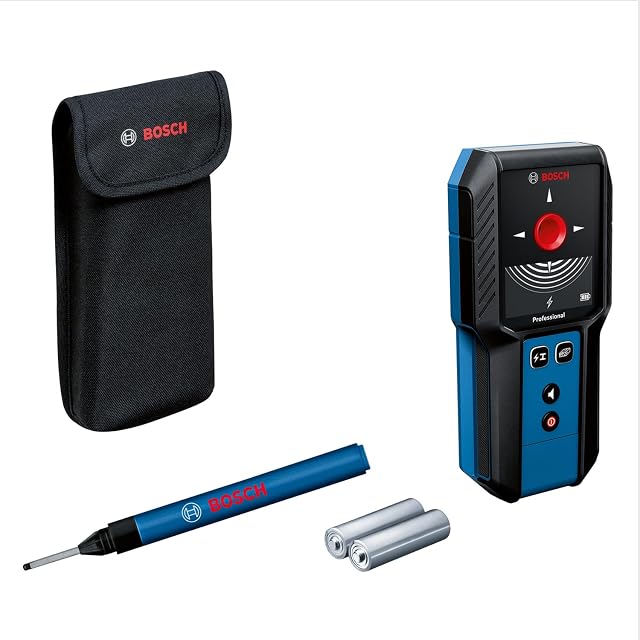
- Calibrate on the wall you are about to drill. Hold the detector flat against a spot you believe is clear and press the calibration button. Every reading afterwards is relative to that.
- Scan slowly, in both directions. Left to right, then right to left. The two passes rarely agree exactly, and the middle of the disagreement is the object.
- Scan vertically too. Studs are vertical, and cables run vertically from sockets — a horizontal scan alone will cross a cable without ever running along it.
- Mark the edges, then the center. A detector with a center indication does this in one pass; without one, find both edges and mark the middle.
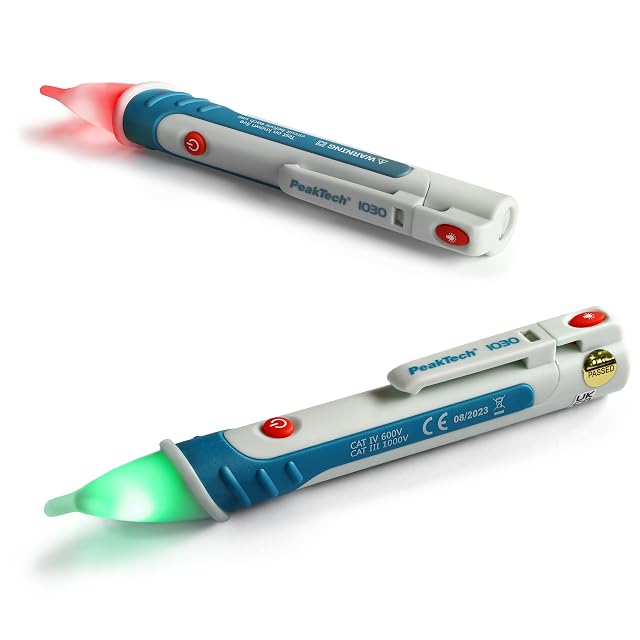
- Run a voltage pen along the line before drilling. A pen that responds where the detector said nothing is a reason to stop.
What defeats a detector
- Damp plaster, which conducts and looks like metal.
- Foil-backed plasterboard, which is a continuous metal sheet as far as the tool is concerned.
- Metal lath and mesh, same problem.
- Depth. Wood detection is typically limited to around 19 mm (0.75 in); two layers of board plus a skim is at or past that.
The zones to assume are occupied
Regardless of the detector: directly above and below every socket and switch, horizontally between them, and in a band near the ceiling. Cables are routed in those zones by convention in many countries, and drilling into one there is the classic accident.
What this page will not do
Tell you it is safe to drill. A detector is an indication. Follow the manufacturer instructions for your tool, follow the rules that apply where you live, and where the wall or the circuit makes the risk real, hand it to someone qualified.
Drill shallow first
If you are going in anyway, go in a few millimeters at a time and look. It is slower than it sounds and faster than the alternative.
What gets asked here
Why does depth vary by material?
Because the detection mechanism differs. Wood, non-magnetic metal and a live cable are found three different ways at three different depths, and a single figure on the box is always the deepest of them.
Why calibrate on the wall?
Wall build-ups vary enormously — plasterboard, plaster on brick, foil-backed board, metal mesh. A detector calibrates against the construction in front of it, and one that has not been calibrated there is reading against an assumption.
Where are cables most likely to run?
Vertically and horizontally from sockets, switches and light fittings, and along horizontal zones near the ceiling. Assume a cable is present in those zones regardless of what the detector says.
Last reviewed 31 August 2026