Skip to content

Wintact Infrared thermometer, −50 to 590 °C (-58 to 1094 °F) vs KETOTEK Infrared thermometer, fixed emissivity 0.95

Does a fixed 0.95 emissivity matter?

Both thermometers are 12:1, both cover roughly −50 to 600 °C (-58 to 1112 °F), and both read in half a second. One has emissivity adjustable from 0.10 to 1.00; the other is fixed at 0.95 and says so plainly. On matt surfaces they agree. On shiny metal they do not.

Wintact WT320 infrared thermometer aimed at a radiator, laser dot visible

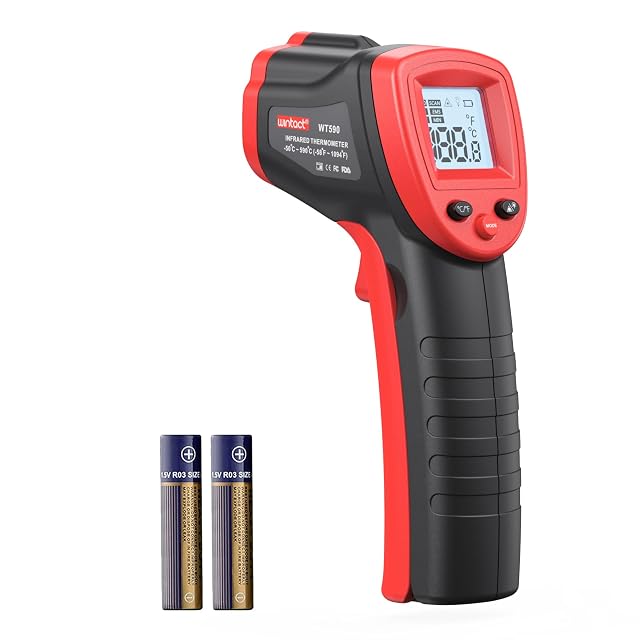
Wintact Infrared thermometer, −50 to 590 °C (-58 to 1094 °F)

6.9/10

Wins 2 of 7

Check price

≈ $19

KETOTEK KT600Y infrared thermometer measuring the surface of a cooking hob

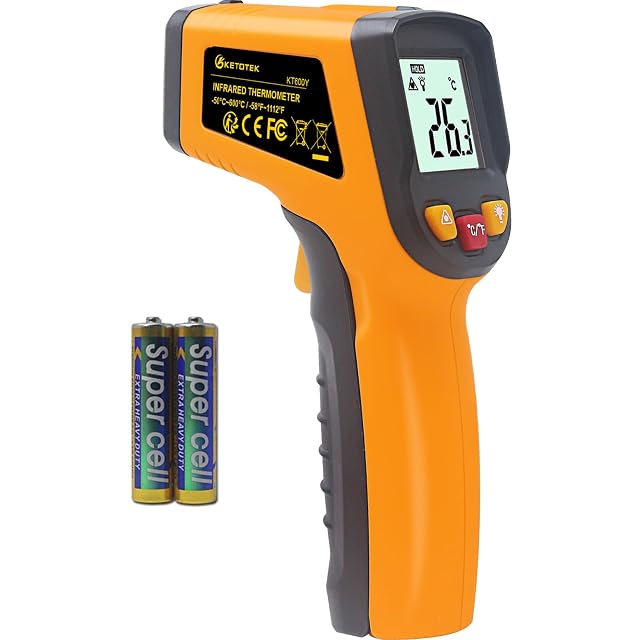
KETOTEK Infrared thermometer, fixed emissivity 0.95

8.1/10

Wins 3 of 7

Check price

Tolerance against tolerance

Compared on Infrared thermometer, −50 to 590 °C (-58 to 1094 °F) Infrared thermometer, fixed emissivity 0.95
Emissivity Adjustable 0.10 – 1.00 Fixed at 0.95
Distance-to-spot ratio 12:1 12:1
Temperature range −50 to 590 °C (-58 to 1094 °F) −50 to 600 °C (-58 to 1112 °F)
Stated accuracy Not published Not published
Response time Not published Under 500 ms
Usable on bare metal Yes, with emissivity set No, without a matt patch
Batteries supplied Not published Two supplied
Listed on amazon.com Yes Yes

A tick marks the better answer on that line only. Counting ticks does not decide the page — the two verdicts below do, because these products answer different questions.

Which of the two, for which tolerance

Buy the Wintact Infrared thermometer, −50 to 590 °C (-58 to 1094 °F)

Buy the Wintact if anything you measure is metal. Adjustable emissivity is the difference between a reading and a wrong number, and nothing on the instrument warns you when 0.95 is inappropriate.

Buy the KETOTEK Infrared thermometer, fixed emissivity 0.95

Buy the KETOTEK for matt surfaces — cooking, radiators, plaster, plastic, wood — where 0.95 is close to correct anyway, and appreciate that it states its limitation instead of hiding it.

What gets asked here

What is the workaround for a fixed-emissivity thermometer?

A patch of matt insulating tape on the shiny surface. The tape reaches the surface temperature and radiates like matt tape, which is close to 0.95 — so you measure the tape instead of the metal. It works with any thermometer.

How wrong can a fixed 0.95 be on metal?

Polished metal can have an emissivity below 0.1, and it reflects its surroundings rather than radiating. The error is large and always in the same direction: the reading is too low.

Each one at length