Etched graduations survive what printed ones do not · review
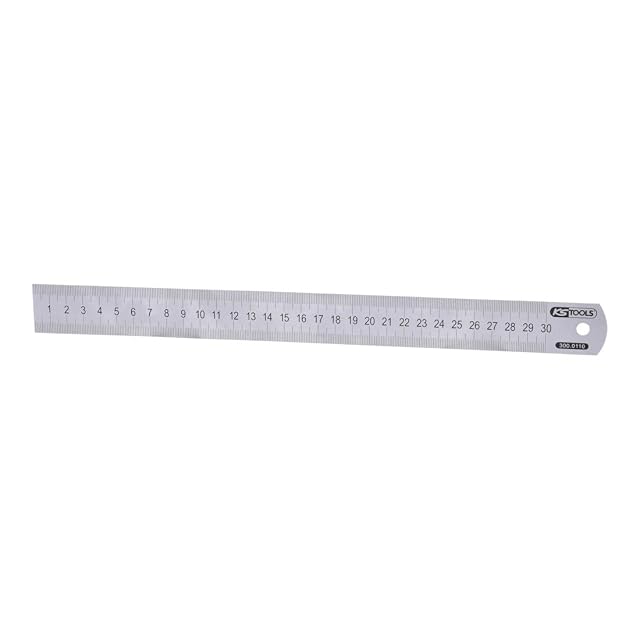
BAUHELD Stainless scribing rule, 300 mm (11.8 in) review
The only rule in this hub that states an accuracy class, and it states the tightest one: EC class I, on 1 mm (0.04 in) stainless with a deep-lasered double scale, made in Germany.
What the figures leave us with The reference rule. Class I stated, laser-cut graduations, and the only tolerance figure published in this family.
One rule in this hub tells you how accurate it is. This is it.
What the manufacturer publishes
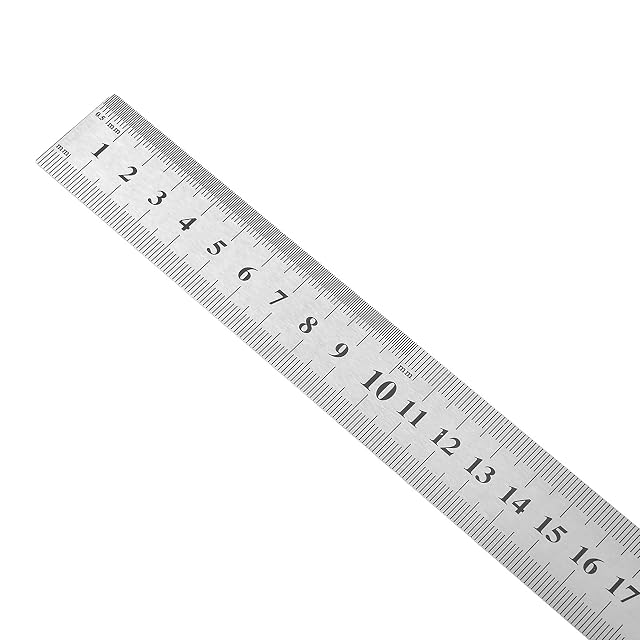
Stainless steel, 1 mm (0.04 in) material thickness, stated to give an exceptionally stable scribing rule. A double measuring scale — centimeters on one side, inches on the other — deep-lasered rather than printed. EC accuracy class I, stated as meeting the highest requirements for dimensional stability and accuracy. All materials sourced in Germany.
Why a class matters on a rule and not on a tape
A tape is read against a hook that floats, held by a hand, against a surface that may not be flat. Its error budget is dominated by everything except the graduations. A rule is laid flat on the work and read directly, so the graduations are the error. That is why an accuracy class is a meaningful specification here and largely decorative on a 5 m (16 ft) tape.
The thickness question
One millimeter is thin. It makes the rule light and lets it sit flush into a rebate, and it is less material than a heavy straightedge would want under a sharp knife. If the rule’s main job is guiding a blade, a thicker one takes that better; if its job is measuring and scribing, 1 mm (0.04 in) is right.
Availability
No such listing: the American Amazon shop answers the reference with a search box rather than a page.
Read from Keepa on the day this page was last revised; stock and price both move without notice.
What it has, and what it lacks
Strengths
States EC accuracy class I — the tightest of the three classes, and the only class marking in this hub
One millimeter of stainless, stated as giving an exceptionally stable scribing edge
Deep-lasered double scale, centimeters one side and inches the other
Materials stated as sourced in Germany
Compromises
Scales on opposite faces, so switching units means turning the rule over
Three times the price of the aluminum pack here
One millimeter is thin for a rule used heavily as a cutting straightedge
Specifications
Amazon reference
B09F7SHYVK (identical on 5 markets)
EAN
4260728550348
Stated dimension or range
300 mm (11.8 in) stainless · 1 mm (0.04 in) thick
Also stated
EC accuracy class I
Scale
deep-lasered scale
What gets asked here
What does EC accuracy class I mean?
It is a marking the manufacturer applies, describing the permitted deviation of the graduations, and class I is the tightest of the three. BAUHELD states class I for this rule. We report the marking as a manufacturer statement; this site is not a verification body.
Is a class I rule worth it?
It is if the rule is your reference — the thing you check a tape or a caliper against. For measuring a shelf, the class is far below the pencil in the error budget.
What is deep lasering?
The graduations are burned into the steel rather than printed on it, so they survive abrasion. It is the same argument as the etched Hedue rule in this hub, by a different process.
Our score
8.2/ 10
The reference rule. Class I stated, laser-cut graduations, and the only tolerance figure published in this family.
This one’s price among measuring instruments
A reference exists on these Amazon stores: France, Germany, Italy, Spain, United Kingdom. Listed is not the same as in stock — availability changes daily.
Details checked on August 31, 2026.
Who should pick this one, among measuring instruments
The rule the other tools get checked against, and the one to scribe along.
Accessories stated to fit this instrument
Listed because the accessory names this instrument itself.
Amazon reports what buyers took in the month before this page was last checked: at least 50.
The figure is a floor, rounded by Amazon, and read through Keepa — it says what buyers picked, not what a maker claims.
Sources
Specifications: the manufacturer sheet for measuring instruments and the matching Amazon product page. Prices and availability: Keepa. Every figure on this page names its source.
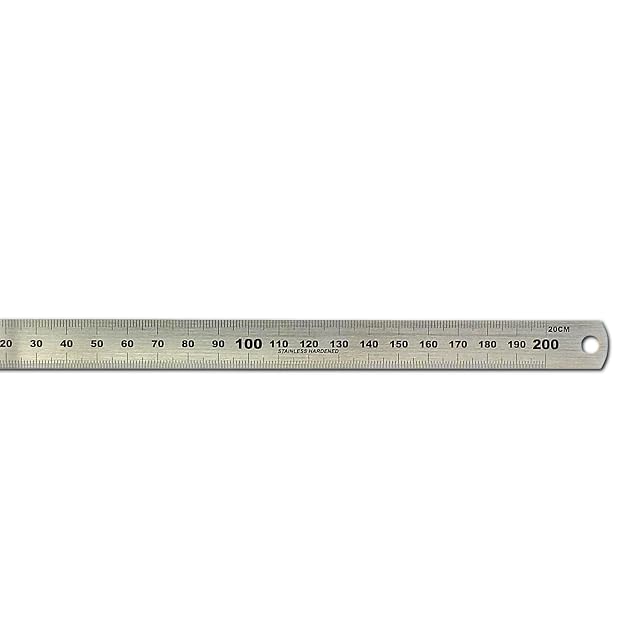
200 mm (7.87 in) stainless · etched scale both sides · non-glare finish
A 200 mm (7.87 in) stainless rule with permanently etched graduations on both faces and a non-glare surface — the two construction choices that decide whether a rule is still readable in five years.
Best for: Bench work where the rule is read dozens of times a day and needs to stay legible.