What the figures leave us with Buy it for the flex, which is a genuine and specific capability. Do not buy it expecting a specification sheet.
A rule that bends is a different instrument, and this one is sold on that alone.
What the manufacturer publishes
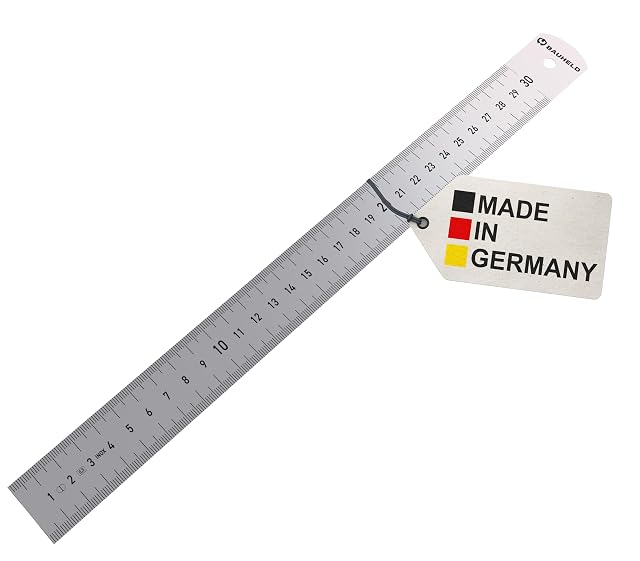
A semi-flexible steel rule, 300 mm (11.8 in), sold singly. That is the full extent of the published specification.
What semi-flexible buys
Measuring the circumference of a pipe, the development of a curve, or the length of a molding that is not straight — all of these need a scale that lies down on the work. A rigid rule cannot, and a tape can but reads through its own case and its own curvature. A spring-steel rule sits flat against the surface and is read directly against it.
What it gives up
It is not a straightedge. Pressed against by a knife it will deflect, and the cut will follow the deflection. It also cannot be trusted to check flatness, which is a rigid rule’s other job. If a single rule has to do everything, the rigid ones in this hub are the safer choice.
Availability
Read on the day this page was built: $29 at the American Amazon shop.
Read from Keepa on the day this page was last revised; stock and price both move without notice.
Prices quoted in this text were read on 31 August 2026. The live price is at the top of the page.
What it has, and what it lacks
Strengths
Semi-flexible: it follows a curved surface instead of bridging it
Three hundred millimeters, the general-purpose bench length
A trade brand with a catalog reference, so replacements match
Compromises
The listing states almost nothing — no accuracy class, no graduation method, no finish
Semi-flexible means it is not a straightedge: it will follow whatever it is pressed against
More expensive than the rigid Hedue rule, with less published about it
Specifications
Amazon reference
B001NZ1VLI (identical on 6 markets)
EAN
4042146067482
Stated dimension or range
300 mm (11.8 in)
Material
semi-flexible spring steel
What gets asked here
What is a semi-flexible rule for?
It bends along its length so it can be laid around a cylinder, into a shallow curve or against a molding, and read there. A rigid rule spans the chord instead and reads short.
Can I use it as a straightedge?
No, and that is the trade. A rule that flexes to follow a curve also flexes under a knife, so it cannot guarantee a straight cut. If you need both, you need two rules.
Does KS Tools publish an accuracy class?
Not in this listing. It states the length, the material and the pack quantity. We do not print a figure we cannot source.
Our score
7.4/ 10
Buy it for the flex, which is a genuine and specific capability. Do not buy it expecting a specification sheet.
This one’s price among measuring instruments
A reference exists on these Amazon stores: France, Germany, Italy, Spain, United Kingdom, United States. Listed is not the same as in stock — availability changes daily.
Details checked on August 31, 2026.
Who should pick this one, among measuring instruments
Measuring around curves and into shallow radii, where a rigid rule cannot sit down.
Sources
Specifications: the manufacturer sheet for measuring instruments and the matching Amazon product page. Prices and availability: Keepa. Every figure on this page names its source.
300 mm (11.8 in) stainless · 1 mm (0.04 in) thick · EC accuracy class I · deep-lasered scale
The only rule in this hub that states an accuracy class, and it states the tightest one: EC class I, on 1 mm (0.04 in) stainless with a deep-lasered double scale, made in Germany.
Best for: The rule the other tools get checked against, and the one to scribe along.
200 mm (7.87 in) stainless · etched scale both sides · non-glare finish
A 200 mm (7.87 in) stainless rule with permanently etched graduations on both faces and a non-glare surface — the two construction choices that decide whether a rule is still readable in five years.
Best for: Bench work where the rule is read dozens of times a day and needs to stay legible.