Etched graduations survive what printed ones do not · review
SenZee Metal rule pair, 30 cm (11.8 in) and 15 cm (5.9 in) review
Two rules in one pack, 30 and 15 cm (5.9 in), in aluminum alloy with centimeters and inches on the same face and a conversion table printed on the back.
What the figures leave us with A pair of handy rules rather than a reference. Fine on a desk, outclassed on a bench.
Two rules for five euros, and the honest description is convenient rather than precise.
What the manufacturer publishes
Hard aluminum alloy construction, described as robust, durable and not easily broken. A pack containing a 30 cm (11.8 in) and a 15 cm (5.9 in) rule. Centimeter and inch scales on the same face. A conversion table on the reverse.
Where aluminum shows
Steel rules exist because a rule is used as a straightedge as much as a measuring device — a knife or a scribe runs along it. Aluminum takes that damage, and once the edge has a nick every subsequent line finds it. The BAUHELD and Hedue rules in this hub are stainless for exactly that reason.
What the pack is for
Fifteen centimeters is the length that lives in a pocket and gets used twenty times a day for depths, gaps and small parts. Thirty is the one you go and find. Owning both is the point of this pack, and it is a reasonable five euros.
Availability
Catalogued and unsold: the American Amazon shop lists the reference with nobody behind it.
Read from Keepa on the day this page was last revised; stock and price both move without notice.
What it has, and what it lacks
Strengths
Two lengths in one pack — the short one is the one you actually reach for
Both scales on the same face, so the rule does not have to be turned over mid-measurement
A conversion table printed on the back
Aluminum alloy, described by the maker as robust and not easily broken
Compromises
Aluminum, not steel: softer, and the edge marks more easily than the stainless rules here
No accuracy class stated
No indication of whether the graduations are etched or printed
Specifications
Amazon reference
B0BJZF16HF (identical on 6 markets)
EAN
0616519720577
Stated dimension or range
300 mm (11.8 in) (30 cm) + 15 cm (5.9 in)
Material
aluminum alloy
Scale
cm and inch on one face
What gets asked here
Is aluminum a problem for a rule?
It is softer than stainless steel, so the working edge picks up nicks from knives and scribes more readily. For measuring it is fine; for cutting against, a hardened steel edge lasts far longer.
Why does having both scales on one face matter?
A rule with metric on one side and imperial on the other has to be flipped to switch, and flipping it means re-registering the zero against the workpiece. On one face, both are read from the same position.
Does SenZee state an accuracy class?
No. The BAUHELD rule in this hub states EC accuracy class I; this listing states none.
Our score
7.6/ 10
A pair of handy rules rather than a reference. Fine on a desk, outclassed on a bench.
This one’s price among measuring instruments
A reference exists on these Amazon stores: France, Germany, Italy, Spain, United Kingdom, United States. Listed is not the same as in stock — availability changes daily.
Details checked on August 31, 2026.
Who should pick this one, among measuring instruments
A desk, a craft bench or a toolbox where a rule is handy rather than authoritative.
Sources
Specifications: the manufacturer sheet for measuring instruments and the matching Amazon product page. Prices and availability: Keepa. Every figure on this page names its source.
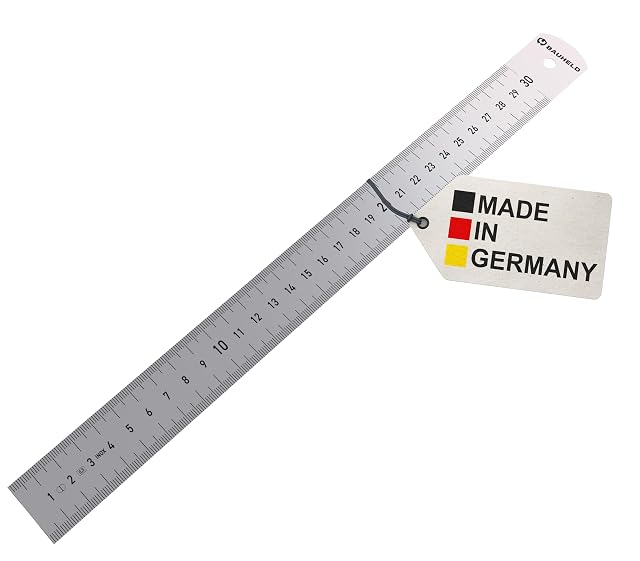
300 mm (11.8 in) stainless · 1 mm (0.04 in) thick · EC accuracy class I · deep-lasered scale
The only rule in this hub that states an accuracy class, and it states the tightest one: EC class I, on 1 mm (0.04 in) stainless with a deep-lasered double scale, made in Germany.
Best for: The rule the other tools get checked against, and the one to scribe along.
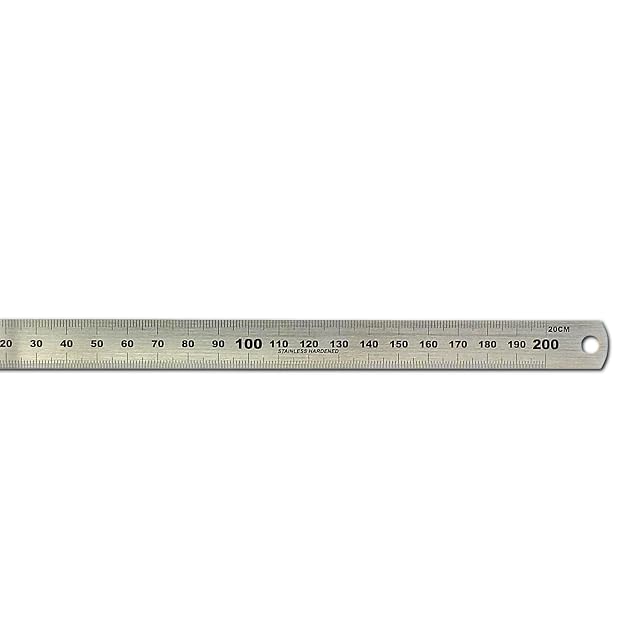
200 mm (7.87 in) stainless · etched scale both sides · non-glare finish
A 200 mm (7.87 in) stainless rule with permanently etched graduations on both faces and a non-glare surface — the two construction choices that decide whether a rule is still readable in five years.
Best for: Bench work where the rule is read dozens of times a day and needs to stay legible.