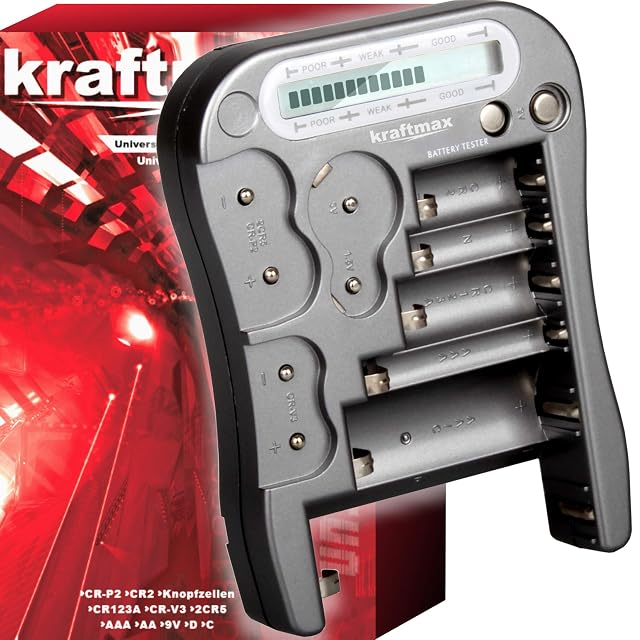
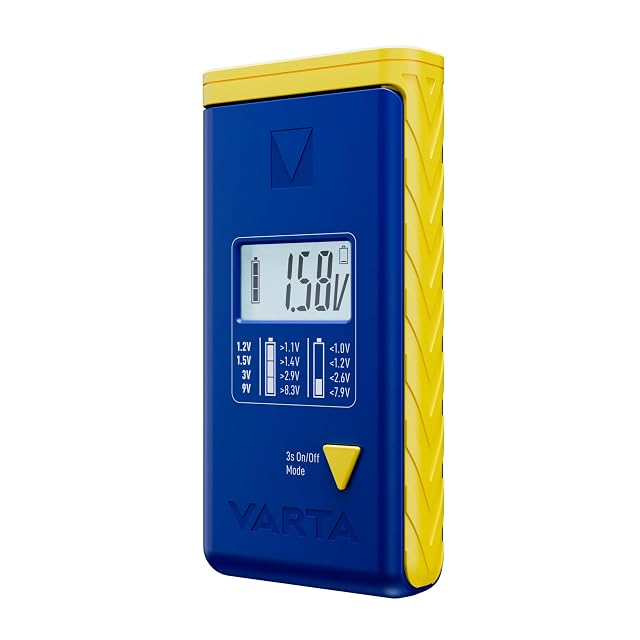
What the figures leave us with The one that accepts photographic lithium cells. That is the reason to choose it over the cheaper testers here.
The widest cell list in this hub, including the ones people actually waste.
What the manufacturer publishes
Testing of the common household batteries — AA, AAA, C, D and 9 V — as well as CR123A, CR2 and button cells. A clear LCD display showing the battery state as GOOD, WEAK or LOW. Simple use requiring no technical knowledge: insert the cell and read the result.
The lithium cells are the point
CR123A and CR2 cells cost several euros each and live in equipment that is used intermittently — cameras, torches, sensors, alarm contacts. They are replaced on suspicion far more often than on evidence, because nothing in the house can test them. A tester with a cradle for them pays for itself in cells not thrown away.
The coarser readout
Three states instead of a number is less information. It is also unambiguous, which for a tool used by whoever finds it in the drawer is a defensible design.
Availability
No such listing: the American Amazon shop answers the reference with a search box rather than a page.
Read from Keepa on the day this page was last revised; stock and price both move without notice.
What it has, and what it lacks
Strengths
Covers CR123A and CR2 lithium cells, which the other testers here do not list
A three-state readout — GOOD, WEAK, LOW — that needs no interpretation
Handles the full household range alongside the photographic cells
Usable without technical knowledge, by design
Compromises
A three-state readout is coarser than a voltage
No statement about load or chemistry handling
Not found on the British or American markets
Specifications
Amazon reference
B07L57MJ94 (identical on 4 markets)
EAN
0742354328347
Power
AA / AAA / C / D / 9 V / CR123A / CR2 / button cells
Display
three-state LCD
What gets asked here
Why do CR123A and CR2 matter?
They are 3 V lithium cells used in cameras, torches, sensors and alarms. They are expensive, they are thrown away while still good, and most household testers have no cradle for them.
Is GOOD / WEAK / LOW enough?
For deciding whether to fit a cell, yes. For tracking how a cell is aging, no — a numeric voltage is more informative, and the TFA Dostmann here gives one.
Does it need its own battery?
The listing does not say. Battery-free testers draw from the cell being tested; this one is not described either way.
Our score
7.8/ 10
The one that accepts photographic lithium cells. That is the reason to choose it over the cheaper testers here.
This one’s price among measuring instruments
A reference exists on these Amazon stores: France, Germany, Italy, Spain. Listed is not the same as in stock — availability changes daily.
Details checked on August 31, 2026.
Who should pick this one, among measuring instruments
Anyone with camera, torch or sensor lithium cells that no other tester in this hub accepts.
What buyers actually choose
Amazon reports what buyers took in the month before this page was last checked: at least 200.
The figure is a floor, rounded by Amazon, and read through Keepa — it says what buyers picked, not what a maker claims.
Sources
Specifications: the manufacturer sheet for measuring instruments and the matching Amazon product page. Prices and availability: Keepa. Every figure on this page names its source.
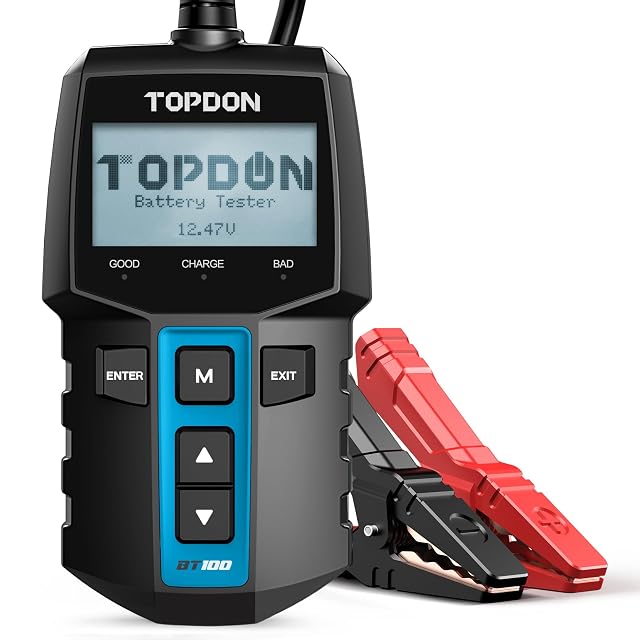
6 V and 12 V lead-acid · 100–2000 CCA · battery, starter and charging tests
A different instrument from the rest of this hub: a vehicle battery tester using conductance measurement to check a 6 V or 12 V lead-acid battery, its starter draw and its charging system.
Best for: Diagnosing a car that will not start, where the question is the battery, the starter or the alternator.