What the figures leave us with Simple and unspecified. The TFA Dostmann costs less and tells you the voltage.
A tester sold on ease rather than on what it measures.
What the manufacturer publishes
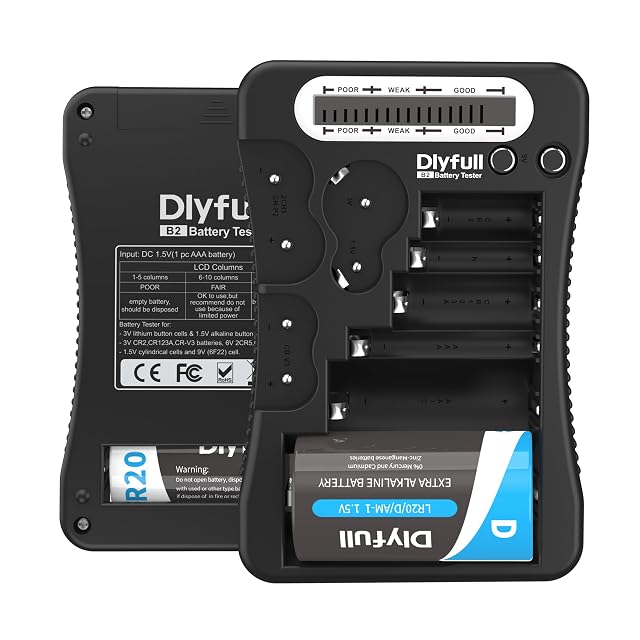
Compatibility with AAA, AA, C and D cells and 9 V blocks, for batteries and rechargeables. A high-quality LCD display showing the charge state quickly and reliably. Simple operation with no complicated setup: insert the battery and check the state immediately.
What “no setup” trades away
A tester with no chemistry selection has to assume one. That assumption is almost always the 1.5 V alkaline scale, which reads a fully charged 1.2 V rechargeable as partly flat. For a household drawer that is a minor irritation; for someone running a set of rechargeables it is a systematic error.
Where it sits in this hub
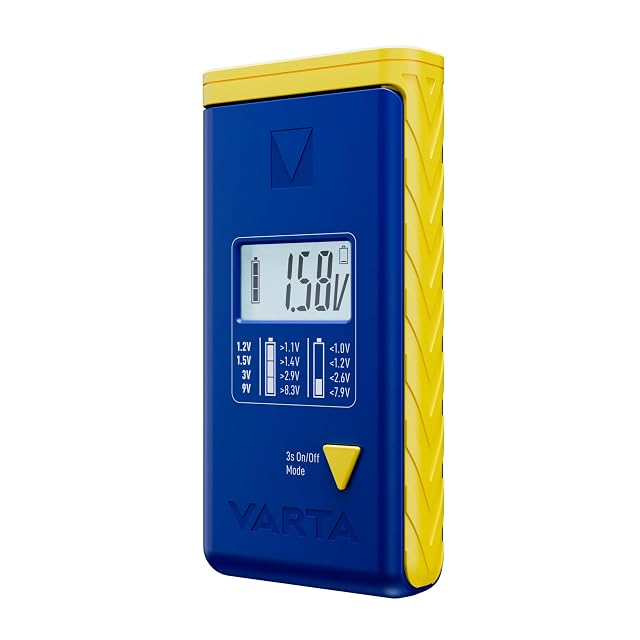
Between two testers that publish more: the TFA Dostmann states its voltages and shows volts, and the VARTA states four chemistries. This states sizes and a display.
Availability
Catalogued and unsold: the American Amazon shop lists the reference with nobody behind it.
Read from Keepa on the day this page was last revised; stock and price both move without notice.
What it has, and what it lacks
Strengths
Covers AAA, AA, C, D and 9 V blocks, primary and rechargeable
No setup: the cell goes in and the state comes up
An LCD charge indication described as fast and reliable
Compromises
No voltage figure mentioned — the listing describes a charge state only
No statement about load, chemistry selection or accuracy
Not found on the British or American markets
Specifications
Amazon reference
B08B8XF32H (identical on 6 markets)
EAN
4051287055203
Power
AAA / AA / C / D / 9 V blocks · LCD charge state
Functions
no setup
What gets asked here
Does it show a voltage?
The listing describes an LCD showing the charge state, without stating that a voltage is displayed. The TFA Dostmann in this hub states volts explicitly.
Does it handle rechargeables?
kraftmax states compatibility with batteries and rechargeable cells across the listed sizes, without specifying how the 1.2 V nominal of NiMH is handled.
Is "no setup" an advantage?
For a shared household tool, yes — a tester with a chemistry switch gets left on the wrong setting. For accuracy on rechargeables, an explicit chemistry selection is better.
Our score
7.6/ 10
Simple and unspecified. The TFA Dostmann costs less and tells you the voltage.
This one’s price among measuring instruments
A reference exists on these Amazon stores: France, Germany, Italy, Spain, United Kingdom, United States. Listed is not the same as in stock — availability changes daily.
Details checked on August 31, 2026.
Who should pick this one, among measuring instruments
A household tester where the only question is whether to bin the cell.
What buyers actually choose
Amazon reports what buyers took in the month before this page was last checked: at least 200.
The figure is a floor, rounded by Amazon, and read through Keepa — it says what buyers picked, not what a maker claims.
Sources
Specifications: the manufacturer sheet for measuring instruments and the matching Amazon product page. Prices and availability: Keepa. Every figure on this page names its source.
6 V and 12 V lead-acid · 100–2000 CCA · battery, starter and charging tests
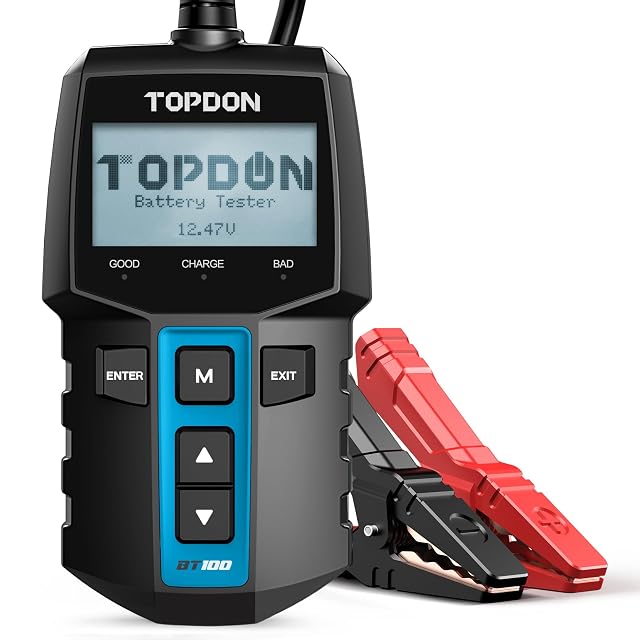
A different instrument from the rest of this hub: a vehicle battery tester using conductance measurement to check a 6 V or 12 V lead-acid battery, its starter draw and its charging system.
Best for: Diagnosing a car that will not start, where the question is the battery, the starter or the alternator.