A resting voltage flatters a cell; a load test does not · review
TFA Dostmann BatteryCheck, digital battery tester review
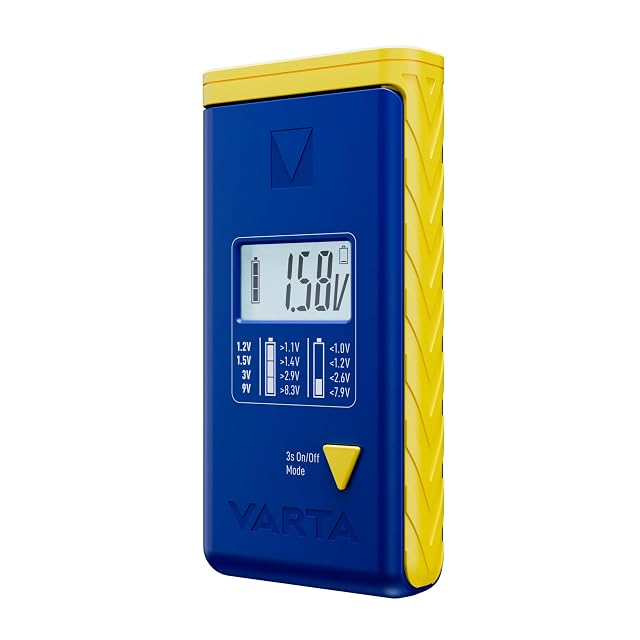
A tester covering almost every household cell at 1.2, 1.5, 3.0 and 9 V, displaying the remaining voltage in volts alongside a color-scaled charge state.
What the figures leave us with The one that shows you a number instead of a color. That alone makes it the more useful of the two cheap testers here.
A tester whose output is a voltage rather than a verdict.
What the manufacturer publishes
Suitability for almost all battery types — primary cells and rechargeables in AAA, AA, C and D — plus button cells at 1.2 V, 1.5 V, 3.0 V and 9 V. Simple operation for quick checking of batteries and rechargeables, described as ideal for establishing the charge state of cells found in a drawer. A digital display giving the remaining battery voltage in volts, with a color-scaled charge state.
Number against color
Every cheap battery tester shows a green-amber-red scale. Only some also show the voltage. The difference matters because the scale is calibrated to one assumption about what “good” means, and the voltage lets you apply your own — a 1.3 V alkaline is fine for a clock and useless for a camera flash.
What is still unstated
Whether the cell is loaded during the reading. It is the specification that separates this category from a voltmeter, and neither of the two cheapest testers here states it.
Availability
Catalogued and unsold: the American Amazon shop lists the reference with nobody behind it.
Read from Keepa on the day this page was last revised; stock and price both move without notice.
What it has, and what it lacks
Strengths
States the voltages it handles — 1.2, 1.5, 3.0 and 9 V — rather than just cell sizes
Displays the remaining voltage numerically as well as a color scale
Covers rechargeables as well as primary cells
Positioned for exactly the right job: checking a drawer of found batteries
Compromises
No statement about whether a load is applied
Not found on the American market
Color scaling is interpretation, not measurement
Specifications
Amazon reference
B08XQNZWYP (identical on 6 markets)
EAN
4009816036285
Power
AAA / AA / C / D · button cells
Voltage measurement
1.2, 1.5, 3.0 and 9 V · voltage in volts
What gets asked here
Why does showing volts matter?
A traffic-light indication tells you the tester's opinion. A voltage lets you form your own: 1.35 V on an alkaline AA is a cell with life left, and no color band conveys that.
What is the 1.2 V setting for?
Nickel-metal-hydride rechargeables, whose nominal voltage is 1.2 V rather than 1.5 V. Testing them against an alkaline scale marks healthy cells as flat.
Does it load the cell?
Not stated. As with the VARTA in this hub, the listing describes the display rather than the measurement method.
Our score
7.8/ 10
The one that shows you a number instead of a color. That alone makes it the more useful of the two cheap testers here.
This one’s price among measuring instruments
A reference exists on these Amazon stores: France, Germany, Italy, Spain, United Kingdom, United States. Listed is not the same as in stock — availability changes daily.
Details checked on August 31, 2026.
Who should pick this one, among measuring instruments
Sorting a mixed drawer, where the numeric voltage is the useful output.
What buyers actually choose
Amazon reports what buyers took in the month before this page was last checked: at least 1,000.
The figure is a floor, rounded by Amazon, and read through Keepa — it says what buyers picked, not what a maker claims.
Sources
Specifications: the manufacturer sheet for measuring instruments and the matching Amazon product page. Prices and availability: Keepa. Every figure on this page names its source.
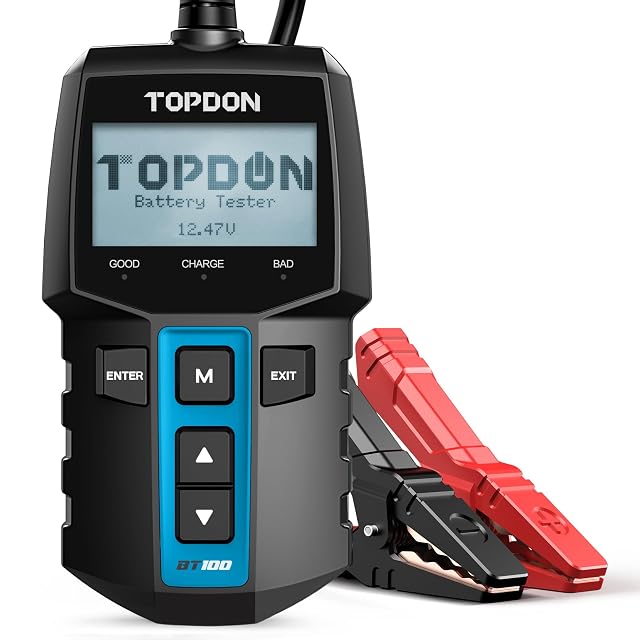
6 V and 12 V lead-acid · 100–2000 CCA · battery, starter and charging tests
A different instrument from the rest of this hub: a vehicle battery tester using conductance measurement to check a 6 V or 12 V lead-acid battery, its starter draw and its charging system.
Best for: Diagnosing a car that will not start, where the question is the battery, the starter or the alternator.