What the figures leave us with An affordable introduction with its central specification unpublished. Read the manual before it is plugged into anything.
Insulation testing at a tenth of the price of the instruments below it, and a listing that leaves out the number that matters.
What the manufacturer publishes
A professional instrument for testing insulation resistance, described as high-precision. Multiple selectable ranges with manual measurement modes. A large digital LCD with backlight. DC voltage measurement.
The specification that is missing
An insulation tester is defined by its test voltages — typically 250 V, 500 V and 1000 V. They decide what the instrument may be used on: too high a voltage applied to sensitive equipment damages it, and too low a voltage tells you nothing about insulation that will see mains. Nothing in this listing states them.
Where this instrument belongs
Insulation measurement is not a casual test. It energizes what it measures, and the procedure — isolate, verify dead, test, discharge — belongs to the manufacturer instructions and to national rules. What this page compares is instruments.
Availability
No such listing: the American Amazon shop answers the reference with a search box rather than a page.
Read from Keepa on the day this page was last revised; stock and price both move without notice.
What it has, and what it lacks
Strengths
The cheapest way into insulation measurement by a wide margin
Several selectable ranges with manual measurement modes
A large backlit LCD
Also measures DC voltage
Compromises
No measurement category published
The test voltages are not listed in the listing — the specification that decides what it may be used on
No named standard
Specifications
Amazon reference
B0BWLW89HY (identical on 5 markets)
EAN
0732168428333
Insulation test
Insulation resistance
Functions
multiple ranges · manual selection
Display
backlit LCD
What gets asked here
What test voltages does it apply?
The listing does not state them. That is the primary specification of an insulation tester: applying 1000 V to equipment rated for 250 V damages it. Read the manual before the first test, and do not assume.
What does an insulation tester actually measure?
It applies a known DC voltage across insulation and measures the resistance that results, in megohms. A low reading means current is finding a path it should not have.
Is this a job for a non-specialist?
The measurement energizes the circuit under test. Isolation, discharge and the procedure itself belong to the manufacturer instructions and the rules that apply where you live. This site compares instruments, not methods.
Our score
7.5/ 10
An affordable introduction with its central specification unpublished. Read the manual before it is plugged into anything.
This one’s price among measuring instruments
A reference exists on these Amazon stores: France, Germany, Italy, Spain, United Kingdom. Listed is not the same as in stock — availability changes daily.
Details checked on August 31, 2026.
Who should pick this one, among measuring instruments
Learning what an insulation test looks like, on equipment that is disconnected and safe to experiment on.
Sources
Specifications: the manufacturer sheet for measuring instruments and the matching Amazon product page. Prices and availability: Keepa. Every figure on this page names its source.
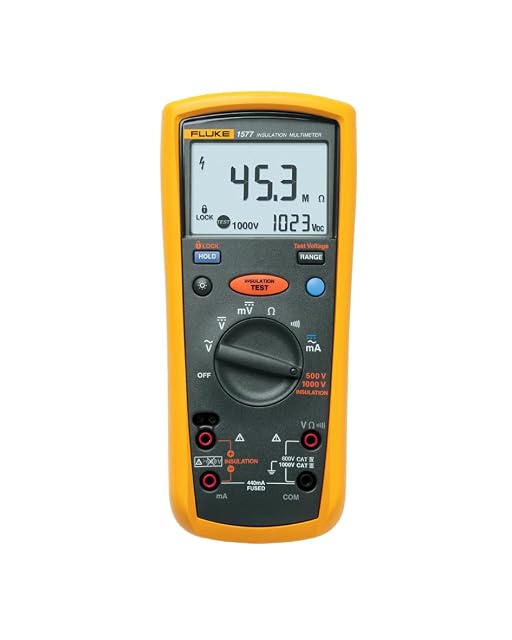
500 and 1000 V test · 600 MΩ · combined insulation tester and multimeter
A combined insulation tester and digital multimeter with 500 V and 1000 V test voltages and a 600 MΩ range, at the top of this hub by a factor of four.
Best for: Carrying one instrument instead of two, in a trade where that trade-off is worth the price.
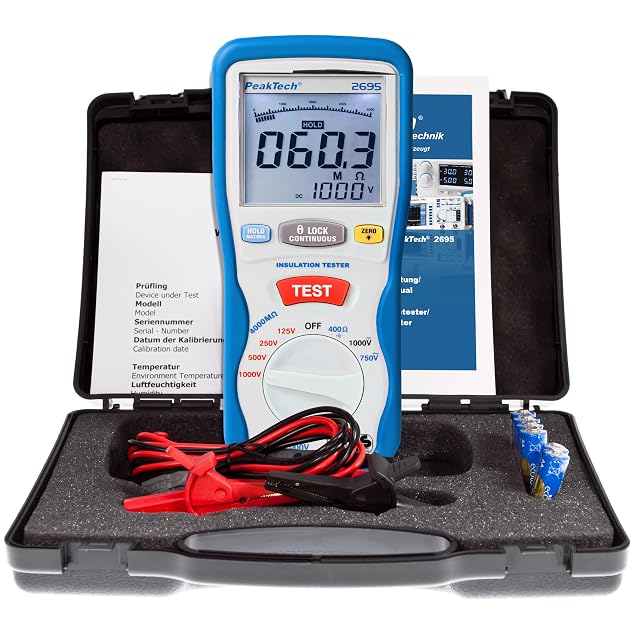
125 / 250 / 500 / 1000 V test · 0–4000 MΩ · CAT III 1000 V · dual display
Four selectable test voltages from 125 to 1000 V, insulation measurement to 4000 MΩ, continuity, AC and DC voltage — and a stated CAT III 1000 V rating.
Best for: Installation work where the test voltage has to match the circuit and the category has to be known.
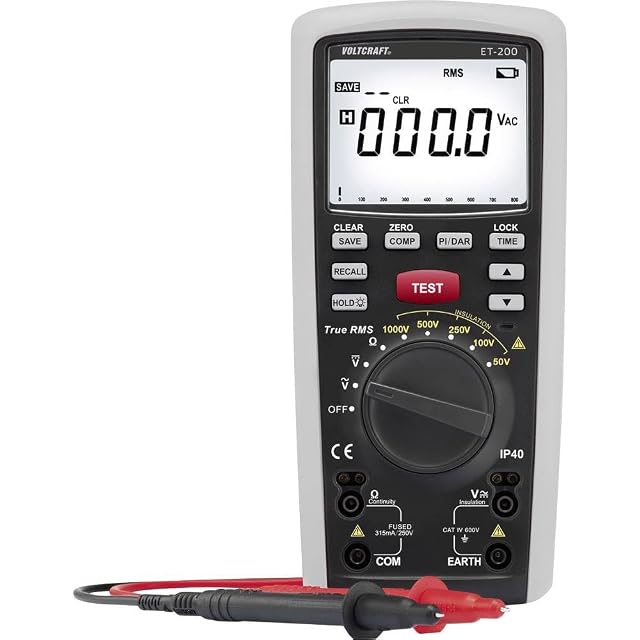
50 / 100 / 250 / 500 / 1000 V · insulation to 20 GΩ · resistance 0.01 Ω–20 kΩ
Five test voltages from 50 to 1000 V and an insulation range reaching 20 GΩ — five times the ceiling of the PeakTech — with low-resistance measurement from 0.01 Ω.
Best for: Testing across a wide span of equipment, from electronics at 50 V to fixed wiring at 1000 V.