The test voltage must match the circuit, not the other way round · review
Voltcraft Insulation tester, five test voltages to 20 GΩ review
Five test voltages from 50 to 1000 V and an insulation range reaching 20 GΩ — five times the ceiling of the PeakTech — with low-resistance measurement from 0.01 Ω.
What the figures leave us with The widest span here, from 50 V to 1000 V and up to 20 GΩ. The absent category rating is the gap.
Five test voltages and the widest measuring window in this hub.
What the manufacturer publishes
Test voltages of 50, 100, 250, 500 and 1000 V. Insulation resistance measurement up to 20 GΩ. Resistance measurement from 0.01 Ω to 20 kΩ.
The two ends of the range, and what each is for
Fifty volts exists for equipment that 500 V would destroy. Twenty gigohms exists so that good insulation produces a reading instead of an over-range symbol — and a reading is what lets you compare this month against last month, which is how insulation is actually monitored.
At the other end, 0.01 Ω resolution is the continuity range: verifying that a protective conductor is genuinely connected, which is a measurement in fractions of an ohm.
What is not published
No measurement category. On an instrument that applies 1000 V and is used on fixed installations, that is the specification a buyer most needs, and it is in the documentation rather than the listing.
Availability
Catalogued and unsold: the American Amazon shop lists the reference with nobody behind it.
Read from Keepa on the day this page was last revised; stock and price both move without notice.
What it has, and what it lacks
Strengths
Five test voltages published, starting at 50 V for sensitive equipment
Insulation measurement to 20 GΩ, the widest range here
Low-resistance measurement from 0.01 Ω, which is the range continuity testing needs
A 50 V step, which the other testers here do not offer
Compromises
No measurement category published
On sale on the German and Italian markets only
No named standard
Specifications
Amazon reference
DE B017REY926 · US B07HQ66G5Q · FR B07HQ66G5Q · IT B017REY926 · ES B07HQ66G5Q
EAN
4016138952742
Insulation test
50 / 100 / 250 / 500 / 1000 V · insulation to 20 GΩ
Functions
resistance 0.01 Ω–20 kΩ
What gets asked here
What is a 50 V test for?
Circuits and components that a higher test voltage would damage — control electronics, low-voltage systems, sensitive equipment. It is the lowest step among the testers here and the only one at that level.
Is 20 GΩ useful?
It is a high ceiling, which means healthy insulation gives a number rather than an over-range indication. Watching that number over time is how insulation degradation is spotted before it fails.
Why does 0.01 Ω resolution matter?
Continuity of a protective conductor is a low-resistance measurement — fractions of an ohm. A tester that resolves to 0.01 Ω can make it; one that reads to the nearest ohm cannot.
Our score
7.5/ 10
The widest span here, from 50 V to 1000 V and up to 20 GΩ. The absent category rating is the gap.
This one’s price among measuring instruments
A reference exists on these Amazon stores: France, Germany, Italy, Spain, United States. Listed is not the same as in stock — availability changes daily.
Details checked on August 31, 2026.
Who should pick this one, among measuring instruments
Testing across a wide span of equipment, from electronics at 50 V to fixed wiring at 1000 V.
Sources
Specifications: the manufacturer sheet for measuring instruments and the matching Amazon product page. Prices and availability: Keepa. Every figure on this page names its source.
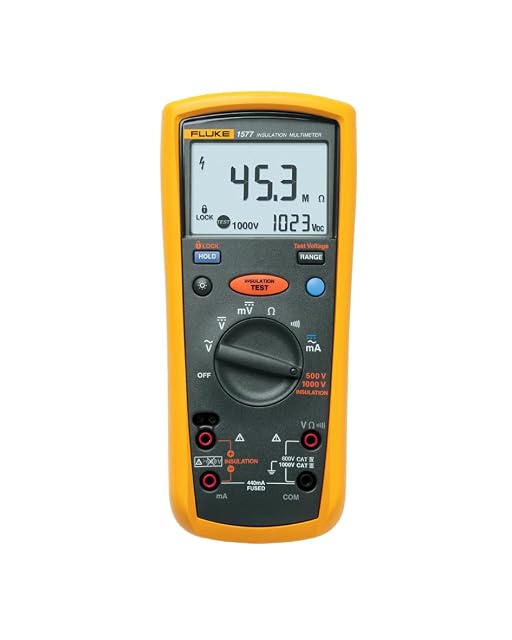
500 and 1000 V test · 600 MΩ · combined insulation tester and multimeter
A combined insulation tester and digital multimeter with 500 V and 1000 V test voltages and a 600 MΩ range, at the top of this hub by a factor of four.
Best for: Carrying one instrument instead of two, in a trade where that trade-off is worth the price.
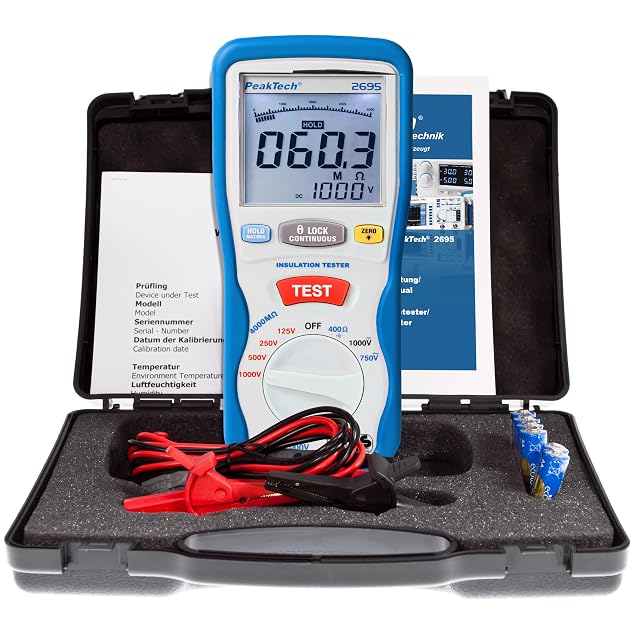
125 / 250 / 500 / 1000 V test · 0–4000 MΩ · CAT III 1000 V · dual display
Four selectable test voltages from 125 to 1000 V, insulation measurement to 4000 MΩ, continuity, AC and DC voltage — and a stated CAT III 1000 V rating.
Best for: Installation work where the test voltage has to match the circuit and the category has to be known.