What the figures leave us with Honest about being a comparison instrument. That is worth more than a percentage that implies a precision it does not have.
A meter that declines to pretend its number is a moisture content.
What the manufacturer publishes
Fast checking of damp spots on walls, floors and masonry. Stated uses include new-build and old-building handovers, cellar checks and documenting damp patches in flats. Readings in a range of 0 to 100, supplied with a compact quick-start guide explaining how the device works, together with the instructions.
Why a relative scale is defensible
Every meter in this hub measures an electrical property and infers moisture from it. The inference depends on the material, its density, its temperature and what is behind it. Printing a percentage makes that inference look like a measurement; printing 0 to 100 says that it is an index.
Neither approach changes the physics. One of them changes what the user believes.
The method that works with either
Reference then compare. A reading of 60 means nothing; a reading of 60 where the same wall reads 20 two meters away means there is something to investigate. That is what this instrument is for, and it is what all the others in this hub are for too.
Availability
No such listing: the American Amazon shop answers the reference with a search box rather than a page.
Read from Keepa on the day this page was last revised; stock and price both move without notice.
What it has, and what it lacks
Strengths
Covers wall, wood, masonry, screed and concrete in one instrument
A relative 0–100 scale, which is honest about what these meters really do
Supplied with a quick-start guide, so the reading has an interpretation attached
Positioned for building handovers, cellar checks and documenting damp in a flat
Compromises
A relative scale is not a moisture percentage and cannot be compared to a specification
No accuracy, depth or material scales published
On sale on the German market only
Specifications
Amazon reference
B0FLK6MV1B (identical on 2 markets)
EAN
4260748930915
Measuring mode
Wall, wood, masonry, screed and concrete
Scale
relative 0–100 scale
Supplied
quick-start guide
What gets asked here
Is a 0–100 scale worse than a percentage?
It is more honest about the same limitation. Cheap meters that display a percentage are still reading a relative electrical property and converting it with an assumed calibration. A 0–100 scale says plainly that the number is a comparison.
How should the readings be used?
Take one where you believe the material is dry, then compare. The difference is the finding; the absolute number is not.
Can it prove a damp problem?
No. It shows where to look. Establishing a cause, and any consequence that follows from it, belongs to someone qualified to assess the building.
Our score
8.1/ 10
Honest about being a comparison instrument. That is worth more than a percentage that implies a precision it does not have.
This one’s price among measuring instruments
A reference exists on these Amazon stores: Germany, Spain. Listed is not the same as in stock — availability changes daily.
Details checked on August 31, 2026.
Who should pick this one, among measuring instruments
Comparing one spot against another during a handover or a survey, with no pretense of an absolute figure.
What buyers actually choose
Amazon reports what buyers took in the month before this page was last checked: at least 500.
The figure is a floor, rounded by Amazon, and read through Keepa — it says what buyers picked, not what a maker claims.
Sources
Specifications: the manufacturer sheet for measuring instruments and the matching Amazon product page. Prices and availability: Keepa. Every figure on this page names its source.
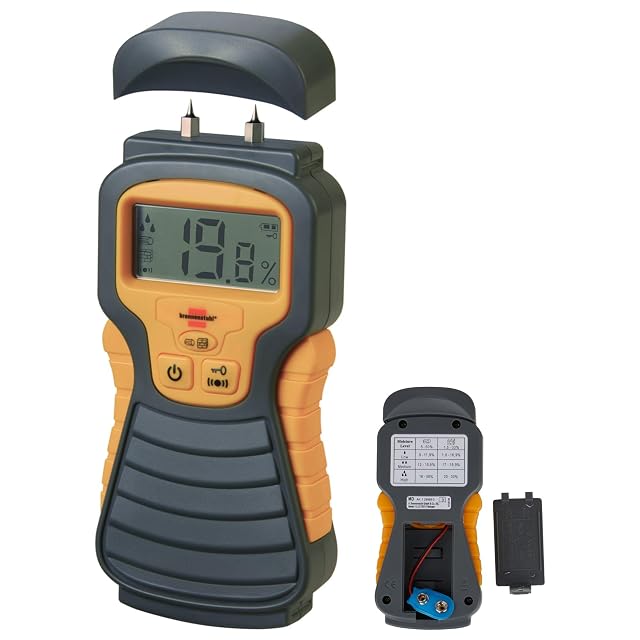
Wood 5–50% · building materials 1.5–33% · hold · auto-off after 3 minutes
A handheld detector publishing two separate measuring ranges — 5 to 50% for wood and 1.5 to 33% for building materials — with a hold function for readings taken out of sight.
Best for: Quick checks on wood and masonry where the comparison between two spots is the answer.
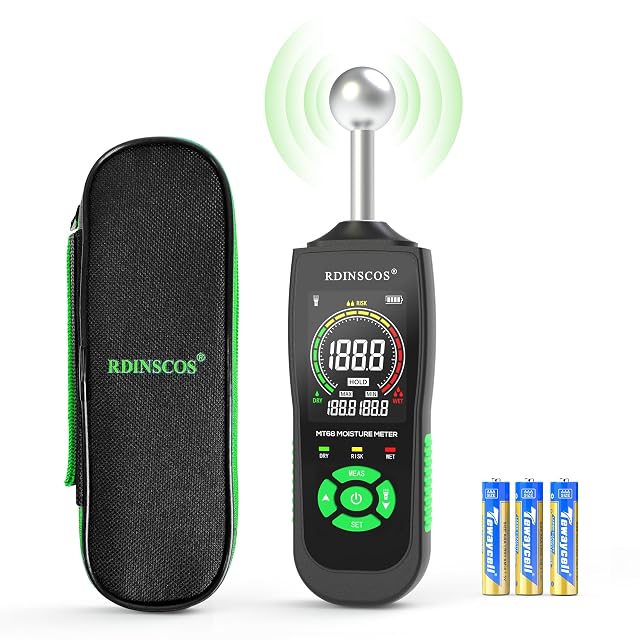
Pinless · to 40 mm (1.57 in) · round probe for corners and joints · hold, max, min
A pinless masonry meter reading to 40 mm (1.57 in) with a rounded probe shaped for corners, joints and narrow spaces, with hold, max and min functions.
Best for: Masonry surveys where readings have to be taken in corners and along joints.
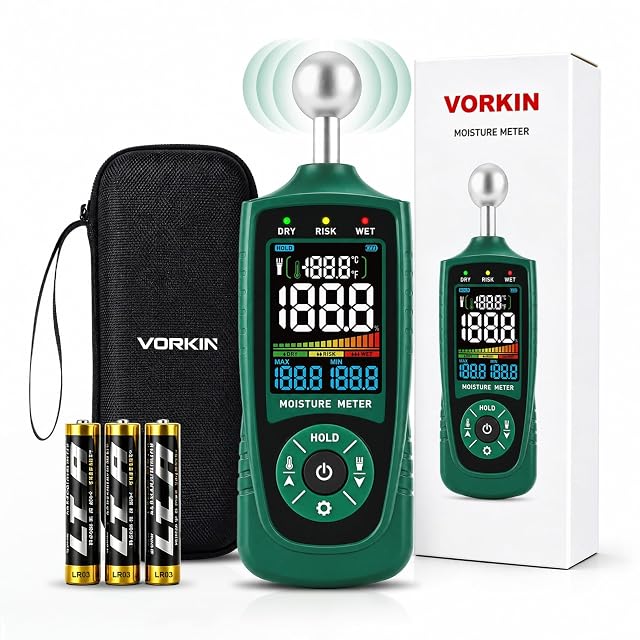
A pinless meter with a ball sensor reading to a stated 40 mm (1.57 in) depth, showing DRY, MID or WET alongside a value, with an adjustable moisture alarm.
Best for: Surveying a finished wall or floor, where holes are not acceptable and depth matters.