Grade rods
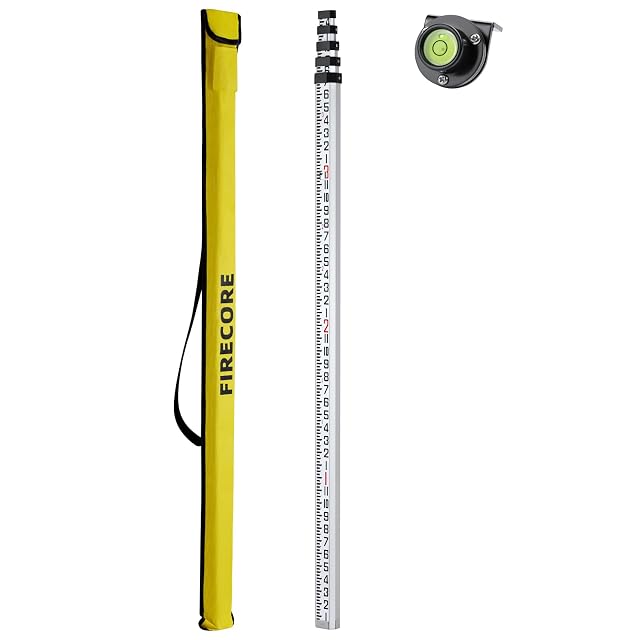
Firecore Grade rod, 16 ft, 5 sections, feet/tenths
The clearest statement of its two faces on this shelf: tenths one side, inches the other, and no claim that either is inverted.
Specifications
- Scale
- Graduations on BOTH sides: front in feet and tenths, back in feet and inches — stated exactly that way, and it is the clearest statement of its two faces on this shelf. Note what it does NOT claim: the back is a different UNIT, not an inverted direction. This shelf's introduction distinguishes those two kinds of second scale, and four listings here blur them
- Body and fittings
- Five telescoping sections reaching 16 ft, with injection-molded sectional joints and high-strength locking buttons stated for extra stability. This shelf's buying tip says to check that every section locks positively; this is one of three rods here that names the locking mechanism at all
- Stated dimension or range
- 16 ft extended, collapsing to 4 ft. Both figures are published — and four feet is the longest fold of the three 16 ft rods on this shelf, where another folds to 42 in
- Material
- Anodized aluminum sections imprinted with weather and corrosion-resistant inks, stated lightweight aluminum alloy. No thickness figure and no alloy designation appears
- Measuring mode
- A bubble level, stated in the title. No tripod thread and no receiver clamp
- Supplied
- Nothing beyond the rod is stated — no bag, no strap, no end caps and no spare parts, where four rods on this shelf include a case
- Amazon reference
- B07VC69SYK
- EAN
- 0782337439530
What the maker puts in writing
- Graduations on both sides: front in feet/tenths, back in feet/inches
- 5 telescoping sections, maximum extended height 16 feet, collapsible to 4 ft
- Anodized aluminum sections imprinted with weather and corrosion-resistant inks
- Injection-molded sectional joints and high-strength locking buttons for extra stability
- Bubble level
No thickness. No alloy. No bag, strap, end caps or spare parts stated.
Two units, not two directions
Which this listing says plainly, and four others on this shelf blur.
Front: feet and tenths, for an engineer’s level. Back: feet and inches, for a
tape.
You read whichever matches the instrument in your hand. That is a conversion
saved.
An INVERTED face is a different thing: it counts from the top down, so a
measurement taken downward from a datum reads directly instead of being subtracted
from the rod length. That is arithmetic saved.
This shelf’s introduction separates the two. One rod on this shelf states its back
face is inverted. This one states its back face is inches.
Both are useful. They are not the same.
Four feet folded
The longest fold on this shelf, and the real cost here.
Four feet does not go behind a van seat, or diagonally into a boot. The rod
travels across the back seats, or on a rack.
A rod that is awkward to carry gets left on site. That is how grade rods go
missing.
The sixteen-foot rod here that folds to forty-two inches solves exactly this.
Five sections of sixteen feet cannot fold much shorter than four. Four sections
would, and would flex more.
And the page lists nothing in the box
Not a bag, not a strap, not end caps.
Four of the six rods on this shelf include a case. One includes a spare lock
button.
A sixteen-foot five-section rod with no case is five open section ends collecting
grit in a van — and grit in a telescopic joint is what makes a section stick, and
then get forced.
Budget for a bag. At the very least for end caps.
Availability
On sale at around 49 € on the American Amazon store at the time of checking.
Prices and availability are what Keepa reported on the date this page was updated; both move.
Prices quoted in this text were read on 8 October 2026. The live price is at the top of the page.